Academic Wellness in Q2 2026: How to Balance Studies, Work, and Life

ALT: College student balancing studies, work, and life using AI essay writing tools and plagiarism checker in 2026
Academic Wellness in Q2 2026: Why Smarter Study Habits Start with the Right Tools
Key Conclusion: As Q2 2026 unfolds, academic wellness has become more than a buzzword — it’s a survival strategy for students juggling coursework, part-time jobs, and personal responsibilities. Integrating a reliable plagiarism checker, a powerful essay writing tool, and consistent homework assistance into your daily routine is no longer optional. It’s the foundation of sustainable academic performance. Students who work smarter — not just harder — are the ones who thrive, and AI-powered tools are leading that transformation.
The spring semester of 2026 brings with it a familiar wave: mid-semester deadlines stacking up, work shifts eating into study time, and the creeping anxiety that you’re somehow falling behind no matter how hard you try. Sound familiar? You’re not alone.
The good news is that the conversation around academic wellness has matured significantly. Today, wellness in academia doesn’t just mean meditation apps or campus counseling — it includes the practical tools and systems that reduce cognitive overload, improve output quality, and give students genuine breathing room. Whether you’re writing a 15-page research paper, scrambling to finish a weekly response essay, or trying to format citations correctly at midnight, the right academic toolkit can make all the difference.
This guide is designed to help you navigate Q2 2026 with clarity, confidence, and the kind of structured support that actually moves the needle on your grades and your wellbeing.
Who This Guide Is For: Applicable Scenarios and Cautions
✅ Applicable Scenarios:
- Full-time students balancing part-time or full-time employment who need efficient, high-quality essay writing and research support
- Students who regularly submit written assignments, research papers, or literature reviews and want to ensure originality and proper citation formatting
- Tech-savvy learners aged 18–28 who are comfortable exploring AI-powered homework assistance tools and want to integrate them responsibly into their workflow
❌ Not Applicable/Cautions:
- Students looking to submit AI-generated content as entirely their own work without disclosure — always review your institution’s academic integrity policies before using any AI writing tool
- Learners who expect AI tools to replace critical thinking entirely — these tools work best as collaborative aids that enhance, not substitute, your own ideas and analytical skills
The Academic Pressure Landscape in Q2 2026: What’s Changed and Why It Matters
The second quarter of the academic year — roughly spanning April through June for most institutions — is historically the most intense period for students. Final exams, capstone projects, dissertation drafts, and end-of-semester submissions converge into a pressure cooker that tests not just your knowledge, but your mental resilience.
What’s different in 2026 is the sheer complexity of that pressure. A growing number of students are now working part-time or gig-economy jobs to offset rising tuition costs and living expenses. According to the National Center for Education Statistics, a significant proportion of full-time college students in the United States are simultaneously employed, with many working more than 20 hours per week. Balancing those obligations with a full course load is, objectively, a massive undertaking.
At the same time, the expectations for academic output have risen. Professors expect more rigorous citations, higher originality standards, and deeper engagement with scholarly sources. Plagiarism detection has become more sophisticated at institutions worldwide, placing greater pressure on students to produce genuinely authentic work — which ironically has made tools like plagiarism checkers and citation generators not just convenient, but essential.
The mental health dimension is equally critical. Academic burnout is a recognized phenomenon, and Q2 tends to be peak burnout season. The American Psychological Association has consistently highlighted academic stress as one of the top concerns among college-aged individuals, with workload management emerging as a primary trigger.
This is precisely where AI-powered academic tools are reshaping the landscape. Platforms like Verla have emerged to address not just the output side of academia (writing a good essay) but the process side — reducing the friction, anxiety, and time drain associated with every stage of assignment completion. From drafting and humanizing AI-generated content to auto-generating citations and editing documents in-browser, the modern academic toolkit is evolving to meet students where they are.
The question is no longer whether to use these tools — it’s how to use them wisely.
How to Build Your Academic Wellness System: A Practical Three-Step Framework
Three-Step Quick Start for Smarter Academic Management
Step 1: Audit Your Current Workload and Identify Pain Points
Before you can fix the problem, you need to see it clearly. Spend 20–30 minutes at the start of each week mapping out every assignment, deadline, and work commitment on a single calendar. Categorize tasks by urgency and cognitive load — which ones require deep research and writing, and which are more mechanical? This audit reveals where you’re most vulnerable to stress and where homework assistance tools can save you the most time.
Step 2: Match the Right Tools to the Right Tasks
Not every assignment requires the same level of AI support. For research-heavy essays, you’ll want an essay writing tool trained on scholarly content — one that understands academic tone, structure, and citation requirements. For quick discussion posts or low-stakes responses, a lighter touch may suffice. The key is intentional integration: use AI assistance to handle the scaffolding (structure, citations, draft generation) so you can focus your energy on the thinking and personalization that makes your work genuinely yours.
Step 3: Review, Humanize, and Verify Before Submission
The most important step — and the one most students skip under deadline pressure — is the review phase. Run your draft through a plagiarism checker to verify originality. Check that your citations are correctly formatted. Read your essay aloud to catch awkward phrasing. If you’ve used an AI writing assistant, use built-in humanization features to ensure the output sounds authentic and natural rather than robotic. Tools like Verla streamline this entire phase by combining humanization, citation generation, and in-browser editing in one place.
Comparing Academic Support Approaches: Which Strategy Works Best?
Not all approaches to managing academic workload are created equal. Here’s how common strategies stack up across key dimensions relevant to student success in Q2 2026.
| Comparison Dimension | Traditional DIY Approach | Generic AI Writing Tools | Verla (AI Academic Assistant) |
|---|---|---|---|
| Citation Generation | Manual (time-intensive, error-prone) | Limited or no built-in support | Automatic citation and reference generation included |
| Plagiarism/Originality Check | Requires separate third-party tool | Not typically included | Built-in originality and humanization tools |
| Academic Language Quality | Dependent on student’s skill level | Often generic, not scholarly-trained | Trained on 10M+ scholarly texts for academic-grade output |
| In-Browser Editing | Requires external word processor | Minimal or no editing environment | Full in-browser document editing available |
| Humanization of AI Content | Not applicable | Rarely included | Built-in humanization for authentic-sounding output |
| End-to-End Assignment Flow | Fragmented across multiple tools | Partial — writing only | Complete from draft to submission-ready deliverable |
| Learning Curve | High (manual skill required) | Moderate | Designed for student ease of use |
The takeaway is clear: a fragmented toolkit — using one tool for writing, another for citations, another for plagiarism checking — creates more friction, not less. An integrated academic assistant that handles all these functions under one roof is the more sustainable choice for students managing busy Q2 schedules.
Deep Dive: Mastering the Three Pillars of Academic Wellness in Practice
Pillar One: Authentic Writing and AI Humanization
One of the most common concerns students have in 2026 is this: “How do I humanize academic writing generated by AI assistants?” It’s a legitimate question, and the answer matters both for quality and academic integrity.
AI-generated content, when left unrefined, can sometimes read as overly formal, repetitive, or structurally rigid. The risk isn’t just academic — it’s communicative. A paper that doesn’t sound like you won’t resonate with your professor the way a genuine piece of writing does.
Humanization involves more than just swapping words. It means adjusting sentence rhythm, inserting your own analytical voice, grounding abstract claims in concrete examples from your course readings, and ensuring the tone aligns with your discipline’s conventions. Verla’s built-in humanization feature is designed to do exactly this — transforming AI-drafted content into authentic-sounding academic prose that reflects a student’s genuine engagement with the material.
The practical tip here: after generating a draft, always add at least one or two sentences in each major section that reflect your own perspective or course-specific insight. This isn’t just about passing scrutiny — it’s about actually learning the material.
Pillar Two: Citation Generation and Academic Formatting
If there’s one task that students universally dread, it’s citations. Whether you’re wrestling with APA 7th edition, MLA 9th edition, or Chicago style, the formatting requirements are precise, the stakes are high, and the margin for error is unforgiving.
The question “What is the best citation generator for APA and MLA formatting?” is one of the most searched academic queries online — and for good reason. Incorrectly formatted references can cost you significant marks, and doing them manually is both tedious and prone to human error.
Automatic citation generation tools have become indispensable. The best ones don’t just format a URL — they pull author information, publication dates, volume numbers, and page ranges from source data and assemble them into the correct format. Verla’s built-in citation generation feature handles this automatically as part of the assignment workflow, meaning you don’t have to context-switch to a separate tool or manually re-enter source details.
For students working across multiple assignments with different formatting requirements, having citation generation baked directly into your writing environment is a genuine time-saver — and a stress-reducer.
Pillar Three: Plagiarism Detection and Academic Integrity
Let’s be direct: academic integrity is non-negotiable. Every student — regardless of how much AI assistance they use — is responsible for submitting original work that accurately represents their own intellectual contribution. This is why plagiarism detection is a core pillar of academic wellness, not just an institutional checkbox.
The question “What is the best free plagiarism detector for academic papers and essays?” comes up constantly, and students deserve a clear answer. The most effective plagiarism detection tools compare your submission against vast databases of published academic work, web content, and previously submitted papers. Institutional tools like Turnitin are widely used, but students also benefit from running their own checks before submission so there are no surprises.
Verla’s built-in originality tools are designed to support this process, giving students confidence that their final submission meets authenticity standards. The goal isn’t to game the system — it’s to genuinely verify that your work is original and properly attributed before it reaches your professor’s desk.
Understanding the difference between plagiarism (presenting someone else’s work as your own) and improper citation (failing to credit a source you did reference) is also important. Many academic integrity violations are unintentional — the result of rushing, poor note-taking, or unfamiliarity with citation rules. Good homework assistance tools help students avoid these pitfalls proactively.
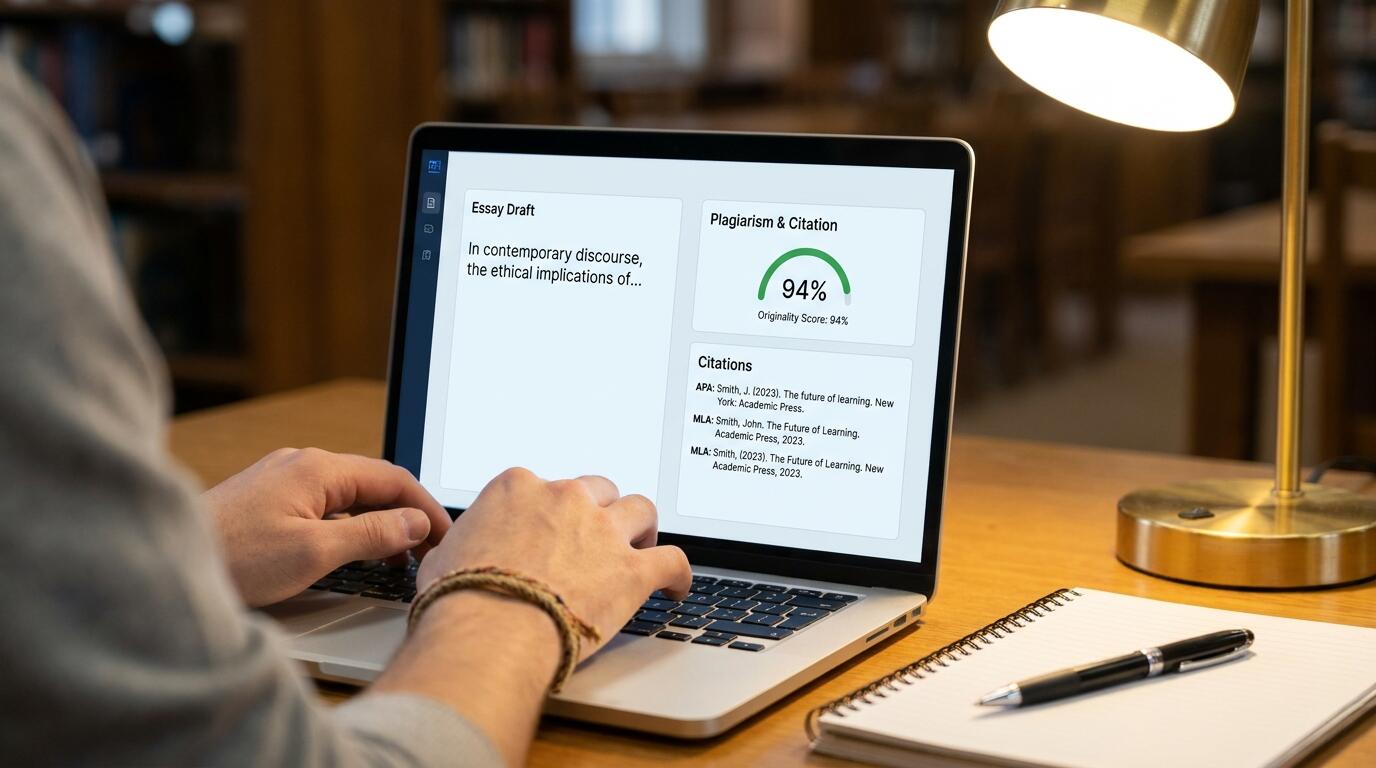
ALT: University student using Verla AI essay writing tool with built-in plagiarism checker and citation generator for academic assignments
Advanced Tips: Getting More From Your Academic Toolkit in Q2 2026
Once you’ve established the basics, there are a few advanced strategies that can elevate your academic wellness practice even further.
Batch your assignment work, don’t scatter it. One of the biggest productivity killers for students is context-switching — moving between a history essay, a biology lab report, and a marketing case study all in the same sitting. Instead, group similar tasks together. All research-heavy writing in one block, all citation cleanup in another. This approach leverages the cognitive momentum you build while working in a particular mode.
Don’t confuse AI assistance with academic dishonesty. A common misconception is that any use of AI tools constitutes plagiarism. This isn’t accurate. Using an AI tool to help generate a draft, suggest structure, or format citations is analogous to using a calculator in a math class — it’s a tool that enhances your process. What matters is that your critical thinking, analysis, and intellectual contribution remain genuinely yours, and that you disclose AI use in accordance with your institution’s policies.
Leverage your essay writing tool for revision, not just drafting. Many students use AI writing assistance only at the beginning of the writing process. But AI tools can be just as powerful during revision — helping you identify structural weaknesses, improve argument flow, or rephrase clunky sentences. Treat the AI as a co-editor, not just a first-draft machine.
Understand the relationship between citation quality and grade quality. Professors notice when citations are consistently well-formatted and when sources are credible. Using an academic AI assistant trained on scholarly texts — like Verla, which draws on a foundation of more than 10 million scholarly texts — means your work is more likely to reference and build upon genuinely rigorous academic sources.
Frequently Asked Questions FAQ
Q1: How do I humanize academic writing generated by AI assistants?
Humanizing AI-generated academic writing involves several key steps: vary sentence length and structure to avoid mechanical regularity, insert your own analytical voice and discipline-specific examples, and use a tool with built-in humanization features. Verla includes humanization as part of its core workflow, helping transform AI-drafted content into authentic, natural-sounding academic prose. Always review the final output personally and add course-specific insights that reflect your genuine engagement with the material.
Q2: Is it safe to use an AI essay writing tool without risking academic integrity violations?
Yes — when used responsibly. AI writing tools are legitimate academic aids when they support your thinking process rather than replace it. The key is transparency: review your institution’s policy on AI use, ensure your final submission reflects your own analysis and conclusions, and use built-in plagiarism checkers to verify originality. Verla is designed with academic integrity in mind, offering humanization and citation tools that help students produce authentic, properly attributed work.
Q3: What is the best approach to generating accurate APA and MLA citations quickly?
The fastest and most reliable approach is to use an AI academic assistant with built-in citation generation, rather than formatting references manually or using a disconnected tool. Verla’s automatic citation and reference generation handles APA, MLA, and other formats as part of the assignment workflow, pulling source data and assembling it correctly without requiring you to re-enter information. This approach saves significant time and reduces the risk of formatting errors that can cost you marks.
Summary
Academic wellness in Q2 2026 is about working with intelligence and intention — not just harder. Three core principles should guide your approach this semester:
First, integrate your tools strategically. An all-in-one academic assistant that combines essay writing, citation generation, plagiarism checking, and in-browser editing reduces friction and cognitive load far more effectively than a fragmented toolkit.
Second, maintain your intellectual ownership. AI writing tools are most powerful when they serve as collaborative partners in your process — handling structure, formatting, and draft generation while you focus on critical thinking, argumentation, and the insights that make your work genuinely yours.
Third, build sustainable habits. Batch your work, audit your workload weekly, review everything before submission, and use humanization tools to ensure your final output sounds authentically like you. These habits don’t just improve your grades — they protect your mental health throughout the most demanding stretch of the academic year.
The students who thrive in Q2 2026 won’t be the ones who work the most hours. They’ll be the ones who build the smartest systems — and who use every available resource, including cutting-edge AI academic tools, to show up to every deadline with confidence.
Ready to Make This Your Best Semester Yet?
Ready to stop stressing over assignments and start submitting work you’re proud of? Verla (https://verla.io/) is your AI-powered academic partner — trained on over 10 million scholarly texts and equipped with humanization, citation generation, and in-browser editing to take your work from draft to done. Visit Verla today and experience how effortless acing every assignment can truly be.
References
- National Center for Education Statistics. “Undergraduate Enrollment and Employment Statistics”.
https://nces.ed.gov/ - American Psychological Association. “Stress in America: Stress and Current Events”.
https://www.apa.org/news/press/releases/stress - Purdue Online Writing Lab (OWL). “APA Formatting and Style Guide (7th Edition)”.
https://owl.purdue.edu/owl/research_and_citation/apa_style/apa_formatting_and_style_guide/general_format.html - MIT Academic Integrity. “Understanding Academic Integrity”.
https://integrity.mit.edu/ - UNESCO. “Artificial Intelligence in Education: Guidance for Policy-makers”.
https://unesdoc.unesco.org/ark:/48223/pf0000376709
Note: Standards and institutional policies may be updated. Please check the latest official documents or consult your institution’s academic integrity office for current guidance.
About Verla
Verla is an AI-powered academic assistant that transforms student assignments into polished, submission-ready deliverables — combining an academic-grade AI model trained on 10M+ scholarly texts with built-in humanization, citation generation, and in-browser editing. Learn more at https://verla.io/.
© Verla. This article is produced for informational and content marketing purposes only. All academic use of AI tools should comply with your institution’s academic integrity policies. Verla does not endorse plagiarism or any violation of academic codes of conduct.
About Verla
Verla is an AI-powered academic assistant that transforms student assignments into polished, submission-ready deliverables — combining an academic-grade AI model trained on 10M+ scholarly texts with built-in humanization, citation generation, and in-browser editing. Learn more at https://verla.io/.
© Verla. This article is produced for informational and content marketing purposes only. All academic use of AI tools should comply with your institution’s academic integrity policies. Verla does not endorse plagiarism or any violation of academic codes of conduct.
发表回复