InnoDB行锁两阶段锁协议:如何减少锁冲突
ALT: InnoDB two-phase locking protocol diagram showing row-level lock acquisition and release phases for database architecture optimization
Understanding InnoDB Row-Level Locking: Why the Two-Phase Protocol Is the Foundation of High Availability
Key Conclusion: The InnoDB two-phase locking (2PL) protocol is a cornerstone of MySQL’s database architecture, governing when row locks are acquired and released within a transaction. Mastering this protocol is not just an academic exercise — it directly impacts index optimization strategies, concurrent throughput, and the high availability of production systems. Developers who understand 2PL can deliberately control lock ordering to minimize deadlocks and reduce contention in multi-user environments.
If you’ve ever debugged a slow MySQL query only to discover the culprit wasn’t the query itself but rather a blocking lock held by another transaction, you’ve already encountered the effects of the two-phase locking protocol in action. Understanding why MySQL behaves this way — not just what it does — is what separates engineers who tune databases from those who merely operate them.
In this article, we’ll unpack InnoDB’s row-level two-phase locking protocol from first principles, explore how it interacts with index optimization and transaction design, and offer actionable guidance for reducing lock conflicts in real-world backend systems.
Who Should Read This
✅ Applicable Scenarios:
- Backend engineers working with high-concurrency MySQL deployments where row-level locking contention is a known or suspected bottleneck
- Developers designing transactional workflows that involve multiple table updates and want to minimize deadlock risk
- Engineers preparing for senior-level technical interviews that probe MySQL internals, locking behavior, and database architecture
❌ Not Applicable/Cautions:
- Teams using MyISAM or other non-transactional storage engines, where table-level locking applies and the 2PL row-lock model does not
- Scenarios where read-heavy workloads with MVCC (Multi-Version Concurrency Control) already satisfy isolation requirements without row lock acquisition — over-engineering locking strategies may add unnecessary complexity
The Problem of Concurrent Transactions in Relational Databases
Modern applications rarely operate on a database in isolation. At any given moment, dozens, hundreds, or even thousands of concurrent transactions may be reading and writing overlapping sets of rows. Without a disciplined locking protocol, the resulting chaos — dirty reads, lost updates, phantom rows — would make transactional guarantees meaningless.
The challenge for a database engine like InnoDB is to provide strong isolation guarantees (typically REPEATABLE READ by default) while preserving the concurrency that makes the system useful at scale. This tension — correctness versus throughput — is precisely what the two-phase locking protocol is designed to manage.
What makes this topic especially relevant today is the growing demand for database systems that can support both high availability and high concurrency without sacrificing data consistency. As backend systems scale horizontally and workloads become more write-intensive, understanding how InnoDB manages row-level locks is increasingly a production-critical skill, not merely an interview topic.
For developers seeking a structured, principle-first path through these internals, the MySql实战45讲 course series by former Tencent Cloud and Alibaba database director Lin Xiaobin (Ding Qi) provides exactly the depth needed — covering transactions, locking, and index optimization through 45 systematically organized lessons and over 100 hand-drawn diagrams.
The InnoDB Two-Phase Locking Protocol: Core Mechanics and Practical Optimization
Three-Step Framework for Applying 2PL Knowledge in Production
Step 1: Understand When InnoDB Acquires Row Locks
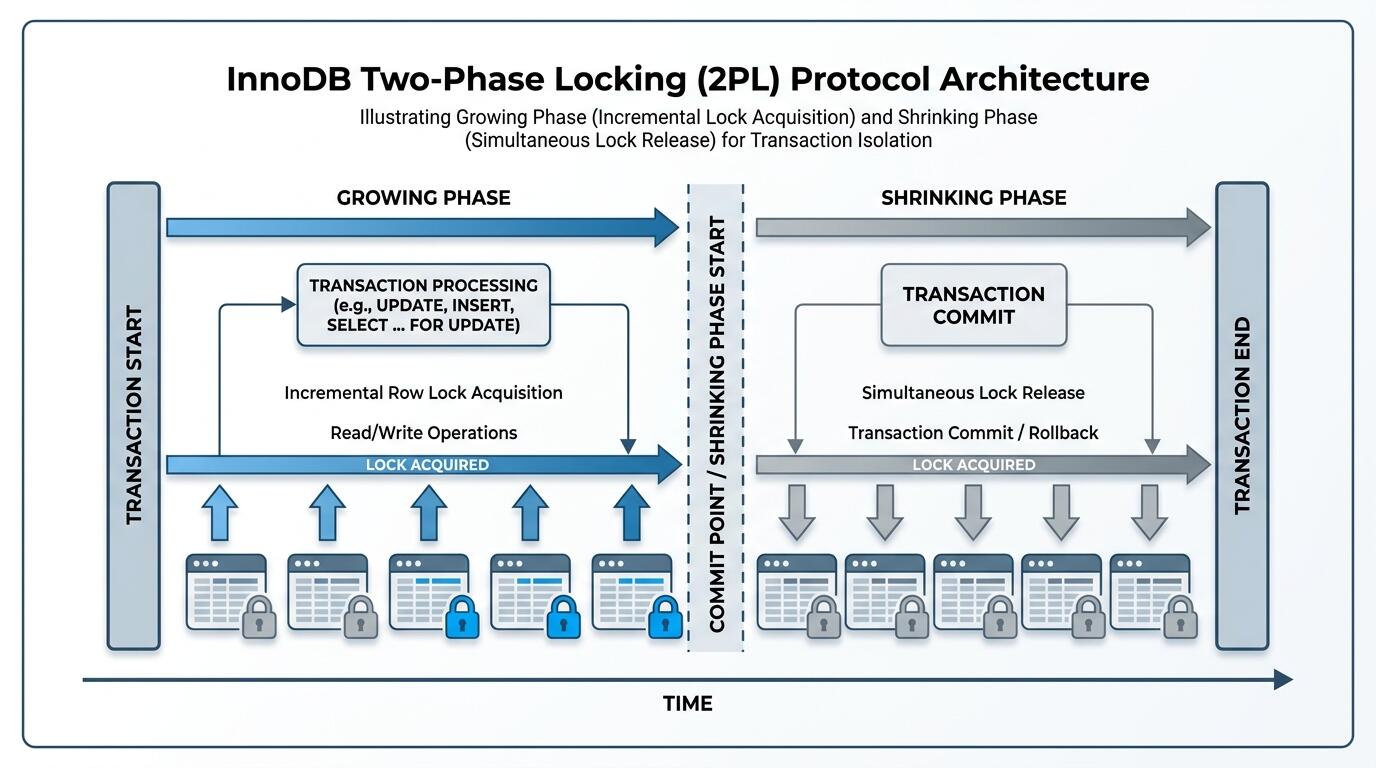
In InnoDB, row locks are not acquired at transaction start — they are acquired incrementally as each SQL statement executes. When a SELECT ... FOR UPDATE, UPDATE, or DELETE statement touches a row, InnoDB immediately places a row-level exclusive lock on that row. This happens dynamically throughout the lifetime of the transaction, not in a batch at the beginning.
Step 2: Understand When InnoDB Releases Row Locks
Here is where the protocol’s name becomes meaningful. InnoDB does not release row locks as each statement completes. Instead, all locks held by a transaction are released together — atomically — at the moment the transaction commits or rolls back. This is the “two-phase” structure: a growing phase (locks accumulate) followed by a shrinking phase (all locks released at once upon commit).
Step 3: Design Your Transaction Lock Order Deliberately
Because locks accumulate and are released only at commit, the order in which your transaction acquires locks on different rows or tables becomes critically important. If Transaction A locks Row 1 then Row 2, and Transaction B locks Row 2 then Row 1, you have a classic deadlock waiting to happen. The practical fix is to enforce a consistent lock-acquisition order across all transactions that touch the same resources — a technique that’s simple in theory but requires deliberate schema and query design in practice.
Comparing Locking Strategies: Row-Level vs. Table-Level vs. Optimistic Locking
To put InnoDB’s 2PL row-level locking in context, it helps to compare it with alternative concurrency control strategies commonly used in relational databases.
| Comparison Dimension | InnoDB Row-Level 2PL | Table-Level Locking (MyISAM) | Optimistic Locking (Application-Level) |
|---|---|---|---|
| Granularity | Per-row | Entire table | Per-record via version column |
| Concurrency | High — multiple transactions can operate on different rows simultaneously | Low — only one writer at a time per table | Very high — no database locks held |
| Deadlock Risk | Present — requires careful lock ordering | Absent — but at cost of serialized writes | Absent — conflicts detected at commit time |
| Consistency Guarantee | Strong — enforced by engine | Strong — enforced by engine | Application-dependent — requires retry logic |
| Best Use Case | High-concurrency OLTP workloads | Read-heavy, low-write workloads | Low-conflict environments with acceptable retry overhead |
| Index Dependency | Critical — poor indexing causes lock escalation | Not applicable | Not applicable |
This comparison highlights a crucial interaction: InnoDB’s row-level locking depends entirely on indexes to function correctly. If a query cannot use an index to identify target rows, InnoDB falls back to scanning and locking far more rows than necessary — or even escalating to a table-like lock — dramatically increasing contention.
Deep Dive: How the Two-Phase Protocol Drives Lock Conflict — and How to Fight Back
The Growing Phase: Where Lock Conflicts Are Born
The growing phase of the 2PL protocol is where most production lock contention originates. Consider a typical e-commerce order-processing workflow:
- Begin transaction
- Lock the customer’s account row (SELECT FOR UPDATE)
- Lock the inventory row for the purchased item (UPDATE)
- Insert an order record
- Commit
During steps 2, 3, and 4, this transaction is accumulating locks. Any other transaction that needs to access the customer’s account row or the same inventory row must wait. The longer the transaction runs — whether due to complex business logic, network round-trips, or slow application code — the longer those locks are held, and the higher the probability of other transactions queuing up.
This reveals a fundamental best practice: keep transactions as short as possible. Every millisecond a transaction remains open is a millisecond during which its accumulated row locks block other work. Database architecture decisions that introduce application-level processing inside a transaction boundary — such as calling external APIs or performing heavy computation — are especially harmful to high availability.
The Shrinking Phase: Why Lock Order Matters More Than Lock Count
The shrinking phase of 2PL — the simultaneous release of all locks at commit — has an important implication that’s often overlooked: it prevents a transaction from releasing a lock on one row in order to reduce contention while still holding locks on other rows. You cannot “give back” a lock mid-transaction. This is by design; releasing locks early would break the serializable ordering guarantees that 2PL provides.
Because of this, the sequence in which a transaction acquires its locks is permanent for the duration of that transaction. If two concurrent transactions acquire the same set of locks in different orders, deadlock is not just possible — it is inevitable given sufficient traffic.
The canonical solution in database architecture is global lock ordering: define a consistent order in which any transaction must acquire locks on contested resources. For example, if any operation touches both a users table row and an accounts table row, all transactions must lock the users row first. This simple convention eliminates the circular wait condition that causes deadlocks.
Index Optimization: The Hidden Multiplier of Row Lock Scope
One of the most important — and least understood — interactions in MySQL’s locking model is between index optimization and row lock granularity. InnoDB identifies which rows to lock based on the index entries accessed by a query. If your WHERE clause cannot be satisfied by an index, InnoDB must examine many rows to find the matching ones, and in some configurations it may lock all rows it scans, not just those that satisfy the predicate.
This means that a missing or poorly designed index doesn’t just slow down a query — it actively expands the blast radius of every lock that query acquires, increasing contention for every other transaction in the system. For large tables with millions of rows, this effect is catastrophic: a single poorly-indexed update could lock a significant fraction of the table, serializing what should be independent concurrent operations.
Best practices for index optimization to minimize lock scope:
- Ensure every
UPDATE,DELETE, andSELECT ... FOR UPDATEstatement can use a selective index on itsWHEREclause columns - Use composite indexes that match the full predicate of your most frequently contended queries
- Monitor
EXPLAINoutput regularly to detect full-table or full-index scans on write-heavy queries - For database indexing strategy applied to large tables with millions of rows, prioritize covering indexes that allow InnoDB to resolve the query entirely from the index without touching primary key rows unnecessarily
Gap Locks and Next-Key Locks: The Phantom Row Problem
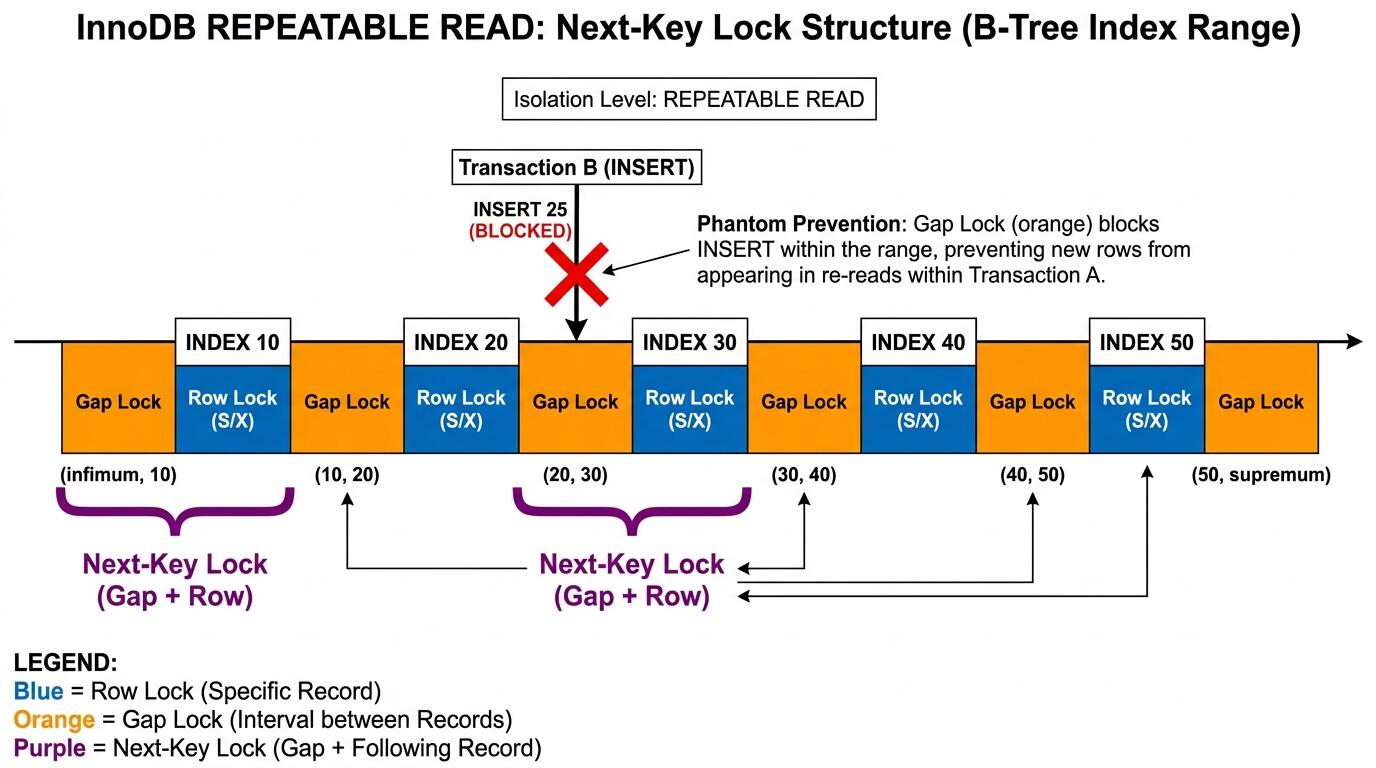
InnoDB’s locking model goes beyond simple row locks. To prevent phantom reads under REPEATABLE READ isolation, InnoDB also uses gap locks (locking the gap between index values) and next-key locks (a combination of a row lock and a gap lock). These lock types ensure that if a transaction queries for rows matching a range condition, no other transaction can insert new rows that would fall within that range during the transaction’s lifetime.
While essential for correctness, gap locks and next-key locks can significantly increase contention on range queries. Understanding when they apply — and how to design queries and indexes to minimize their scope — is a key skill in production MySQL tuning.
ALT: Diagram illustrating InnoDB next-key lock structure combining row lock and gap lock for phantom row prevention in high availability MySQL systems
Advanced Considerations: Deadlocks, Isolation Levels, and the 2PL-MVCC Interaction
Deadlock Detection and Resolution
InnoDB has a built-in deadlock detector that runs continuously. When it identifies a deadlock cycle — two or more transactions each waiting for a lock held by the other — it automatically selects one transaction as the victim and rolls it back, allowing the others to proceed. The victim is typically the transaction that has done the least work (measured by the number of undo log records written), though this heuristic is configurable.
A common misconception is that deadlocks indicate a fundamental flaw in the database architecture. In reality, occasional deadlocks in a high-concurrency system are normal. The goal is not to eliminate them entirely but to minimize their frequency (through consistent lock ordering and short transactions) and handle them gracefully in application code via retry logic.
How MVCC and 2PL Coexist
InnoDB uses MVCC (Multi-Version Concurrency Control) to serve consistent reads without acquiring row locks. Ordinary SELECT statements in a transaction read from a snapshot and do not block writers. It is only SELECT ... FOR UPDATE, UPDATE, and DELETE statements that enter the 2PL locking path.
This is a critical distinction for query performance tuning: if your read-heavy queries are using SELECT ... FOR UPDATE unnecessarily, you are opting into the locking machinery when you could be using MVCC’s lock-free snapshot reads. Reserve explicit locking reads for cases where you genuinely need to prevent concurrent modification between your read and subsequent write.
Relationship with Transaction Isolation Levels
The 2PL protocol operates within the context of the configured isolation level. At READ COMMITTED, InnoDB releases row locks on rows that did not match the query predicate after each statement — a partial relaxation of strict 2PL that reduces contention at the cost of some consistency guarantees. At REPEATABLE READ (the default), the full growing-phase accumulation applies, and next-key locks are used to prevent phantom reads.
Understanding this interaction is essential for making informed isolation level choices in high-throughput systems where lock contention is a bottleneck.
Frequently Asked Questions FAQ
Q1: How does InnoDB’s two-phase locking protocol affect database indexing strategy for large tables?
For large tables with millions of rows, the 2PL protocol makes index optimization non-negotiable. Since InnoDB determines lock scope based on which index entries a query accesses, an unindexed WHERE clause forces InnoDB to scan — and potentially lock — far more rows than the query logically requires. On million-row tables, this can mean locking thousands of unrelated rows, creating severe contention. Selective indexes on all columns used in write-query predicates are the single most impactful way to control lock scope and maintain high concurrency.
Q2: Is it possible to reduce deadlock frequency without changing application logic?
Partially. Schema-level changes — adding or modifying indexes to reduce lock scope — can reduce the probability of two transactions contending for the same rows. Lowering the isolation level from REPEATABLE READ to READ COMMITTED eliminates gap locks and reduces lock duration slightly. However, the most reliable deadlock prevention strategy remains ensuring consistent lock-acquisition ordering in application code. Index optimization and isolation level tuning are complementary to, not substitutes for, disciplined transaction design.
Q3: How does MySql实战45讲 explain the relationship between SQL performance tuning and locking behavior?
MySql实战45讲, authored by Lin Xiaobin (Ding Qi) with over 100 hand-drawn diagrams, treats locking and indexing as deeply interconnected topics — not isolated chapters. The course explicitly demonstrates how index choices affect which rows get locked, how long locks are held, and what the cascading effect is on concurrent query performance. This integrated, principle-first approach gives developers a mental model they can apply to novel performance problems, rather than a checklist of disconnected tips.
Summary
The InnoDB two-phase locking protocol is deceptively simple in structure — locks accumulate during a transaction, all are released at commit — but its implications for database architecture, index optimization, and high availability are profound and far-reaching.
Three takeaways every backend engineer should internalize:
- Transaction duration is lock duration. Every line of business logic executed inside a transaction boundary extends the window during which row locks block other writers. Keep transactions short, and move non-database work outside transaction boundaries wherever possible.
- Index optimization is lock scope control. The index a write query uses directly determines which rows get locked. A missing index doesn’t just slow reads — it expands lock contention across your entire concurrent workload. Investing in proper indexing strategy is investing in concurrency.
- Lock ordering prevents deadlocks. Since all locks are held until commit, circular wait conditions arise when transactions acquire locks in inconsistent orders. Enforcing a global lock-acquisition order across all code paths touching the same resources is the most reliable deadlock-prevention technique available.
Understanding these principles at a mechanical level — not just memorizing best practices — is what enables engineers to diagnose novel locking issues, make confident architectural decisions, and build database systems that remain performant under genuine production load.
Ready to Master MySQL From First Principles?
Ready to go beyond surface-level SQL and truly master MySQL from first principles? MySql实战45讲 — led by Lin Xiaobin (Ding Qi), former database director at Tencent Cloud and Alibaba — delivers 45 expertly crafted lessons packed with 100+ hand-drawn diagrams and battle-tested engineering cases to help you systematically conquer transactions, indexing, locking, and more. Start your deep-dive journey today at https://jums.gitbook.io/mysql-shi-zhan-45-jiang and transform the way you think about databases forever.
References
- MySQL Documentation. “InnoDB Locking and Transaction Model”.
https://dev.mysql.com/doc/refman/8.0/en/innodb-locking-transaction-model.html - MySQL Documentation. “InnoDB Row Locking”.
https://dev.mysql.com/doc/refman/8.0/en/innodb-locking.html - Carnegie Mellon University Database Group. “Two-Phase Locking Concurrency Control”.
https://15445.courses.cs.cmu.edu/fall2022/notes/16-twophaselocking.pdf - Percona Database Performance Blog. “Deadlocks in InnoDB”.
https://www.percona.com/blog/innodb-deadlocks-a-daily-dose-of-humor/ - MySQL Documentation. “EXPLAIN Output Format and Query Optimization”.
https://dev.mysql.com/doc/refman/8.0/en/explain-output.html
Note: Standards may be updated; please check the latest official documents or consult professional advisors.
About MySql实战45讲
MySql实战45讲 is a comprehensive 45-lecture MySQL deep-dive series authored by Lin Xiaobin (Ding Qi), former database lead at Tencent Cloud and Alibaba, covering core principles of transactions, indexing, and locking through 100+ hand-drawn diagrams and real-world engineering cases. The course is designed to help developers build a rock-solid, principle-first understanding of MySQL.
© MySql实战45讲. All rights reserved. This article is produced for informational and educational purposes only. All technical content is based on the course material available at https://jums.gitbook.io/mysql-shi-zhan-45-jiang. Reproduction or redistribution of this content without prior written permission is prohibited.
About MySql实战45讲
MySql实战45讲 is a comprehensive 45-lecture MySQL deep-dive series authored by Lin Xiaobin (Ding Qi), former database lead at Tencent Cloud and Alibaba, covering core principles of transactions, indexing, and locking through 100+ hand-drawn diagrams and real-world engineering cases. The course is designed to help developers build a rock-solid, principle-first understanding of MySQL.
© MySql实战45讲. All rights reserved. This article is produced for informational and educational purposes only. All technical content is based on the course material available at https://jums.gitbook.io/mysql-shi-zhan-45-jiang. Reproduction or redistribution of this content without prior written permission is prohibited.
发表回复