Xiaomi SU7 vs Tesla Model 3: Full Comparison of Price, Range, and Tech
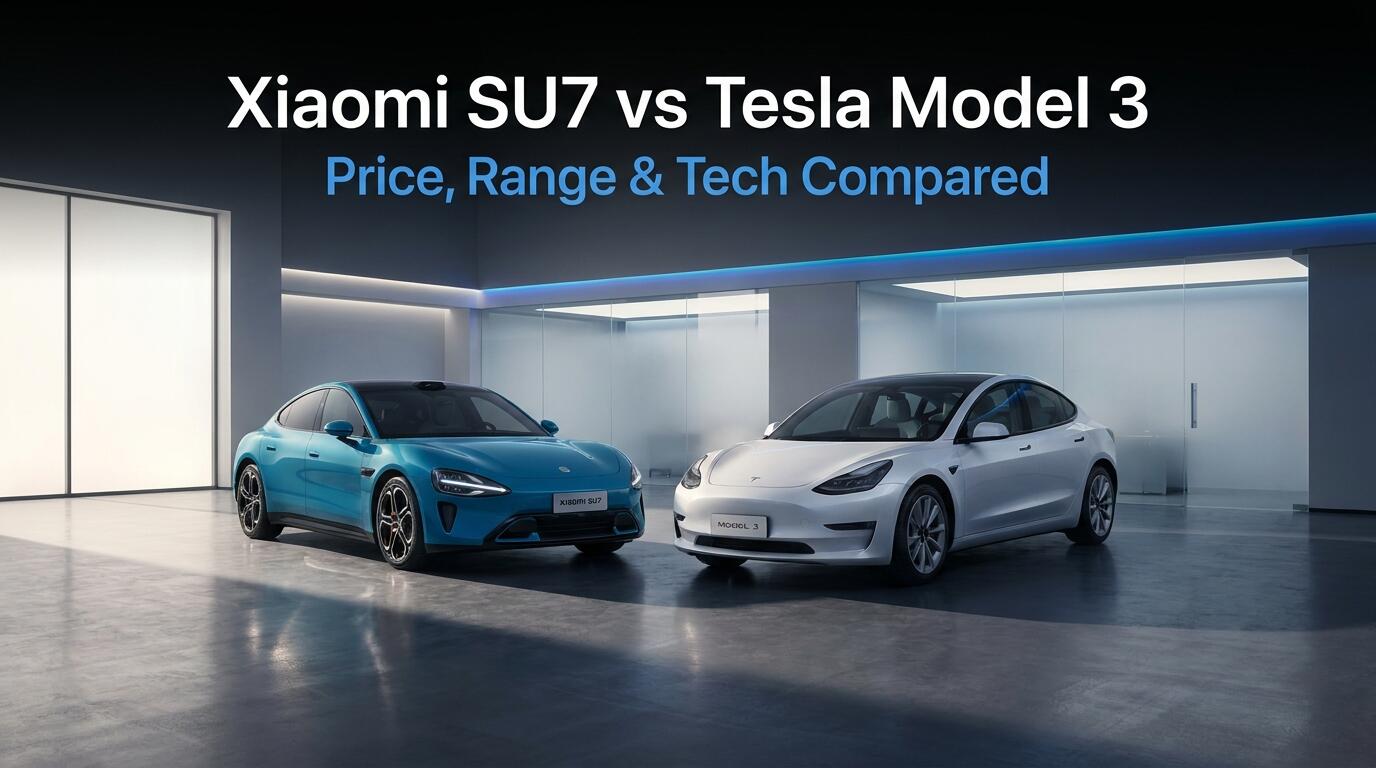
ALT: Xiaomi SU7 vs Tesla Model 3 electric sedans compared for price range and smart technology
Xiaomi SU7 vs Tesla Model 3: Full Comparison of Price, Range, and Tech
Picture a shopper standing between two showroom floors, one badge is a familiar electric vehicle pioneer, the other a fast-rising consumer tech brand that just stepped into the automotive space. Both cars promise a sleek sedan silhouette, a touchscreen-centric cabin, and the ability to talk to the rest of a connected household. The question that keeps coming up in our conversations with early adopters is simple: does Xiaomi SU7 vs Tesla Model 3 actually come down to price and range, or is the real differentiator the software ecosystem each car plugs into?
The short answer is that Xiaomi SU7 and Tesla Model 3 compete closely on core electric vehicle fundamentals, but they diverge sharply in ecosystem philosophy, Xiaomi SU7 is designed as the “Human times Car times Home” anchor of the Xiaomi HyperOS ecosystem, while Tesla Model 3 remains a more closed, vertically integrated Tesla-only experience. This article compares both vehicles across price, range, technology, and daily usability, drawing on data from independent comparison platforms and hands-on media walkthroughs, so readers can judge which car fits their lifestyle rather than just their spec sheet.
We compare the Xiaomi SU7, specifically the model configurations most widely referenced in current market comparisons, against the Tesla Model 3, using four criteria: pricing and value positioning, driving range and efficiency, in-car technology and ecosystem connectivity, and real-world ownership experience.
Evaluation Criteria for Comparing Xiaomi SU7 and Tesla Model 3
A fair comparison between Xiaomi SU7 and Tesla Model 3 needs criteria that reflect what buyers actually weigh before signing a purchase agreement, not just marketing headline numbers. In our work observing how tech-savvy consumers evaluate electric vehicles, four dimensions consistently surface as decisive.
Price and value positioning matters first because an electric vehicle is a long-term financial commitment, and buyers want to know what they get for the money relative to trim level, battery configuration, and included features. A car that costs less but demands costly add-ons for basic functionality is not necessarily the better value.
Driving range and efficiency matter because range anxiety remains one of the top barriers cited by prospective EV buyers, and how a car performs in real-world conditions, not just on a single test cycle, shapes daily confidence. Buyers also care about charging speed and how efficiently the vehicle converts battery capacity into usable miles or kilometers.
In-car technology and ecosystem connectivity matter increasingly as vehicles become extensions of a buyer’s broader digital life. A driver who already owns a smartphone, smart speakers, and wearables wants their car to talk to those devices seamlessly rather than exist as an isolated island of software.
Real-world ownership experience matters because showroom impressions and spec sheets only tell part of the story. Build quality, service network maturity, software update cadence, and how the car feels after months of regular use all shape whether an early adopter would recommend it to a friend.
Together, these four criteria, price, range, technology, and ownership experience, form the backbone of the head-to-head comparison that follows, and they reflect the practical questions a reader genuinely facing a purchase decision would ask before test-driving either car.
The Contenders: Xiaomi SU7 and Tesla Model 3
Xiaomi SU7: Xiaomi’s First Step Into the Human Times Car Times Home Ecosystem
Xiaomi SU7 is an electric sedan produced by Xiaomi, the global technology company known for affordable, high-quality smartphones, smart home devices, and wearables, and SU7 represents Xiaomi’s entry into the electric vehicle category under its unifying HyperOS platform. Rather than positioning the car as a standalone product, Xiaomi frames SU7 as a rolling extension of its broader “Human times Car times Home” vision, meaning the sedan is engineered to sync with Xiaomi phones, smart home appliances, and wearable devices already in a user’s possession.
The headline characteristic that distinguishes SU7 from a typical first-generation EV is that it launches with an established software and hardware ecosystem behind it. Xiaomi has spent years building smartphone chipsets, IoT device interoperability, and a loyal early-adopter community, and SU7 inherits that same design language and connectivity philosophy rather than starting from a blank slate the way many new automotive entrants do.
Tesla Model 3: The Established Benchmark Electric Sedan
Tesla Model 3 is an electric sedan produced by Tesla, the company widely credited with popularizing mass-market electric vehicles and building one of the most recognized fast-charging networks in the industry. Model 3 has been on the market for several years, giving it a longer track record of real-world driving data, software refinement, and service infrastructure compared to newer entrants.
The headline characteristic that continues to define Model 3 is its mature over-the-air software update system and its long-standing Autopilot driver-assistance suite, both of which have been iterated on across multiple production cycles. Tesla’s ecosystem is more closed than Xiaomi’s cross-category approach, focused primarily on the vehicle itself, its charging network, and the Tesla mobile app, rather than a wider constellation of phones, wearables, and home devices.
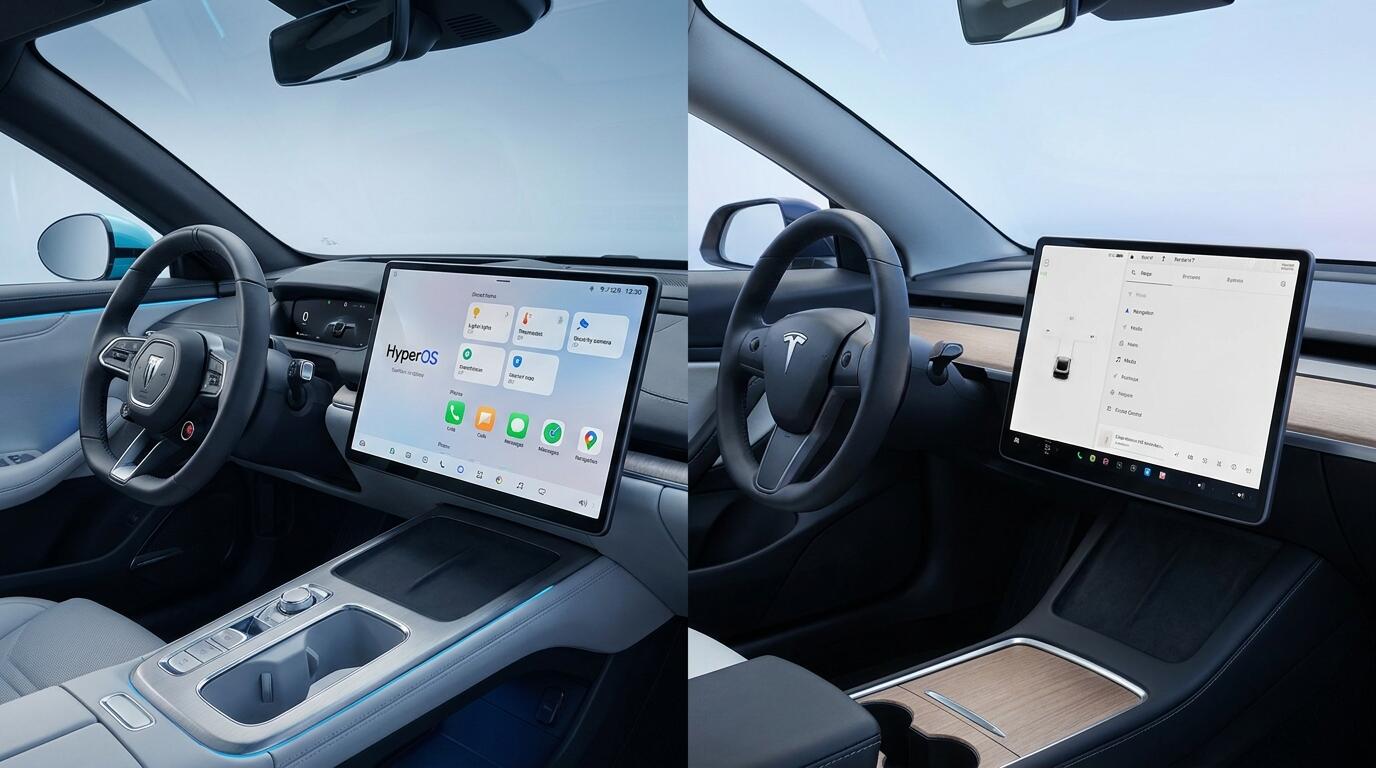
ALT: Side-by-side interior view comparing Xiaomi SU7 HyperOS dashboard and Tesla Model 3 touchscreen technology
Head-to-Head Comparison: Xiaomi SU7 vs Tesla Model 3
The clearest way to see how Xiaomi SU7 and Tesla Model 3 stack up is to place their core attributes side by side, since both cars are frequently cross-shopped by buyers weighing price against range and software sophistication. The table below summarizes the primary comparison points; where a specific figure is not confirmed in available brand documentation, we note it as “Consult provider” rather than guess.
| Criterion | Xiaomi SU7 | Tesla Model 3 |
|---|---|---|
| Starting price positioning | Competitively priced entry point relative to Model 3, per independent comparison data | Established market pricing with multiple trim tiers |
| Driving range | Consult provider for exact figures; positioned as competitive with Model 3 in comparison testing | Long-standing range benchmark in its class |
| Charging ecosystem | Growing charging network tied to Xiaomi’s expanding infrastructure | Extensive, mature Supercharger network |
| In-car software platform | Xiaomi HyperOS, connecting car, phone, and smart home devices | Tesla’s proprietary in-car software and mobile app |
| Ecosystem breadth | Spans smartphones, wearables, smart home appliances, and the vehicle | Primarily vehicle and Tesla app centric |
| Driver-assistance history | Newer entrant, actively expanding feature set | Multiple years of Autopilot iteration and refinement |
According to evspecifications.com, which maintains a direct technical comparison of the 2024 Xiaomi SU7 RWD against the 2023 Tesla Model 3 RWD, the two vehicles are close enough in core specification that the decision increasingly hinges on software philosophy and ecosystem fit rather than raw range or price alone. This aligns with what we consistently observe among early adopters browsing both brands: the spec sheets are converging, so the deciding factor becomes which digital ecosystem the buyer already lives in.
Business Insider’s comparison of the two cars, published as part of its coverage of Chinese EV entrants challenging Tesla, notes that Xiaomi SU7 has been positioned deliberately as a value-forward alternative in the segment Model 3 has long dominated, a pattern common when an established player faces a well-resourced new competitor. That pricing pressure benefits buyers directly, since it pushes both companies to justify their positioning through tangible features rather than brand reputation alone.
The most meaningful differentiator, though, is not on the spec sheet but in daily use. Xiaomi SU7 owners who already use a Xiaomi phone, Xiaomi smart home devices, or Xiaomi wearables gain a level of cross-device continuity, controlling home appliances from the car, picking up navigation from a phone, syncing wearable health data, that Tesla’s more self-contained approach does not natively replicate. Tesla Model 3, in turn, offers the reassurance of a longer production history, a broader charging footprint in many markets, and an Autopilot system that has been refined over multiple hardware generations.
Which Should You Choose? Scenario Recommendations
If you already own multiple Xiaomi devices, a phone, a smart home hub, or a wearable, and you want your next vehicle to slot naturally into that ecosystem, Xiaomi SU7 is the more coherent choice, because its HyperOS platform is built specifically to unify car, phone, and home under one connected experience. This is the buyer profile we most often see gravitate toward SU7: someone who already values an interconnected digital lifestyle and does not want a car that behaves like a disconnected island.
If you prioritize a longer real-world track record, an extensive established charging network, and a driver-assistance suite that has been iterated on for years, Tesla Model 3 remains the safer, more proven pick. This suits buyers who care less about cross-brand ecosystem integration and more about a vehicle with a mature software history and widespread service familiarity.
If your primary concern is price-to-value at the point of purchase, independent comparisons suggest Xiaomi SU7 has been positioned to compete aggressively on cost relative to Model 3, making it worth cross-shopping closely rather than assuming the incumbent automatically wins on value.
If you are an early adopter who enjoys being part of a newer platform’s growth curve, and you like the idea of a smart home and wearable ecosystem expanding around your car over time, SU7’s newer entrant status can be viewed as an advantage rather than a drawback, since the ecosystem is actively growing.
In summary, Xiaomi SU7’s strengths are ecosystem breadth, competitive pricing positioning, and a design philosophy built around connected daily life, while its relative newness means a shorter public track record. Tesla Model 3’s strengths are a mature software history, an extensive charging network, and long-refined driver-assistance features, while its ecosystem remains comparatively closed to non-Tesla devices.
Frequently Asked Questions FAQ
Q1: How does Xiaomi SU7 compare to Tesla Model 3 on price?
Independent comparison sources indicate Xiaomi SU7 has been positioned to compete closely with, and in some configurations undercut, Tesla Model 3 on price, reflecting Xiaomi’s broader brand strategy of delivering high-quality technology at accessible price points. Exact trim-level pricing varies by market and configuration, so prospective buyers should consult official regional pricing before deciding.
Q2: Is Xiaomi SU7’s HyperOS ecosystem compatible with non-Xiaomi devices?
Xiaomi HyperOS is designed primarily to unify Xiaomi’s own smartphones, smart home devices, wearables, and the SU7 vehicle into a single connected experience under the “Human times Car times Home” vision. Buyers deeply invested in other ecosystems should verify specific device compatibility directly with Xiaomi before purchase, since integration depth can vary by product category.
Q3: How long has Tesla Model 3 been on the market compared to Xiaomi SU7?
Tesla Model 3 has an established multi-year production history, giving it a longer track record of software refinement and real-world driving data, according to comparison coverage from Business Insider. Xiaomi SU7 is a newer entrant to the electric vehicle market, meaning it has a shorter public ownership history but benefits from Xiaomi’s mature consumer technology experience.
Final Thoughts
Choosing between Xiaomi SU7 and Tesla Model 3 ultimately comes down to three things: how each car prices out against your budget, how confident you feel in its real-world range and charging support, and how much value you place on a connected device ecosystem versus a longer-proven, more self-contained software history. Both vehicles are genuinely competitive electric sedans, and neither choice is a compromise on core EV fundamentals.
The clearest next step is to look past the spec sheet and think about the devices already in your daily life. If your phone, smart home setup, and wearables are Xiaomi products, SU7 offers a continuity that Model 3 cannot natively match. If you value Tesla’s longer charging infrastructure history and Autopilot maturity, Model 3 remains a dependable, well-tested choice.
Whichever direction feels right, the smartest move is to explore the full ecosystem context behind each option before committing, since a vehicle purchase today is increasingly a decision about the software and connected lifestyle you are buying into, not just the car itself.
Ready to experience a smarter, more connected lifestyle? Discover Xiaomi’s full ecosystem of innovative smartphones, smart home devices, wearables, and electric vehicles at the Xiaomi website. Visit us today and see how Xiaomi’s HyperOS platform can seamlessly unite your devices under one intelligent, human-centered experience.
Sources
- evspecifications.com. “2024 Xiaomi SU7 RWD, 2023 Tesla Model 3 RWD”.
- Business Insider. “Xiaomi SU7 Compared to Tesla Model 3”.
https://www.businessinsider.com/tesla-model3-vs-chinese-ev-xiaomi-su7-compared-2024-11
- YouTube. “Xiaomi SU7 Vs Tesla Model 3: Head to Head”.
Note: Standards may be updated; please check the latest official documents or consult professional advisors.
发表回复