How to Prioritize Your Reading List Efficiently This Semester

ALT: Student prioritizing reading list efficiently using color-coded folders and academic planner this semester
How to Prioritize Your Reading List Efficiently This Semester and Reclaim Your Study Time
Every semester brings a fresh stack of syllabi, each one promising more chapters, articles, and case studies than any single student can realistically absorb in the time available. Reading load has grown heavier across most disciplines as courses increasingly assign supplementary journal articles alongside traditional textbooks, and students without a clear system often default to reading everything in order, cover to cover, regardless of relevance. Prioritizing your reading list efficiently this semester means identifying which texts directly serve your assignments and exams, ranking them by urgency and depth required, and allocating your limited study hours accordingly rather than treating every page as equally important.
This guide is built for undergraduate and graduate students who feel perpetually behind on assigned readings and want a repeatable method rather than a one-time fix. Whether you are managing four courses with overlapping deadlines or a single thesis-heavy semester with dense theoretical texts, the steps below give you a practical framework for triage, scheduling, and follow-through.
Before You Start: Prerequisites & Preparation
Before you can prioritize anything, you need a complete and accurate picture of what has actually been assigned. Gather every syllabus for the semester, along with any supplementary reading lists your instructors have posted separately on the learning management system. Skipping this step is the single most common reason prioritization systems fail midway through the term — students plan around a partial list and get blindsided by readings added later.
You will also need a place to consolidate this information: a spreadsheet, a note-taking app, or a planner works equally well, as long as it lets you sort by date and tag by course. A rough estimate of your available study hours per week is useful too, since prioritization is meaningless without knowing your actual capacity. This preparation phase typically takes a single sitting early in the semester, with light updates as new readings are announced.
Checklist before starting:
- All syllabi and supplementary reading lists collected in one place, including page counts or estimated reading times where available
- A tracking tool chosen (spreadsheet, app, or planner) and a realistic weekly study-hour budget defined
Step-by-Step Instructions
Step 1: Audit Every Reading Assignment Across Your Courses
Start by listing every required and recommended text for the semester in a single master document, organized by course and due date. Include the format of each reading — textbook chapter, peer-reviewed article, case study, or primary source — since format often signals how long it will take to process. Do not filter anything out yet; the goal here is completeness, not judgment.
Tip: Color-code entries by course so that overlapping deadlines across classes become visually obvious at a glance.
Step 2: Classify Each Reading by Purpose and Weight
Once your master list exists, tag each item according to why it was assigned: is it foundational material you will be tested on, background context for a lecture, or source material you will need to cite in a paper? According to guidance from Taylor Pearson’s widely referenced framework on 3 Steps to Prioritizing Your Reading, readings should be sorted by their direct contribution to a specific goal rather than treated as a uniform queue, since not every text carries the same weight toward your outcomes.
Tip: A simple three-tier tag system — essential, supportive, optional — makes later scheduling decisions much faster than re-evaluating each reading from scratch.
Step 3: Rank Readings by Deadline Proximity and Assessment Value
With purpose tags in place, cross-reference each reading against your assignment and exam calendar. A reading tied to next week’s paper outranks one tied to a midterm a month away, even if the latter feels more intellectually interesting. This is also the stage where you separate readings that will be directly assessed from those included mainly for enrichment.
Tip: Readings that will be cited or quoted in a graded assignment should always sit above general background material, regardless of how the syllabus orders them.
Step 4: Match Reading Depth to Reading Purpose
Not every text on your list deserves the same reading strategy. Foundational and exam-relevant readings warrant close, active reading with annotation, while background or optional material can often be handled through skimming, abstract review, or targeted section reading. Pinereads Review notes in Five Tips for Meeting Your Reading Goals During the School Year that matching effort to the goal of each reading session helps students sustain consistent progress without burning out on material that did not require deep engagement.
Tip: For dense journal articles, read the abstract, introduction, and conclusion first to decide whether the full text merits closer attention.
Step 5: Build a Rolling Weekly Schedule Instead of a Fixed One
Rather than assigning every reading to a fixed calendar date at the start of the semester, build a rolling one-to-two-week schedule that you revisit and adjust regularly. Academic workloads shift constantly as instructors add materials or extend deadlines, and a rigid plan set in week one becomes obsolete by week four. Block dedicated reading sessions into your calendar the same way you would block time for a lecture or lab.
Tip: Reserve a recurring weekly slot specifically for re-prioritizing the upcoming week’s readings based on what actually happened the week before.
Step 6: Batch Similar Readings and Protect Deep-Focus Blocks
Group readings by subject or format so you can process similar material in a single sitting rather than constantly context-switching between disciplines. Gretchen Rubin’s approach, discussed in the Next Big Idea Club’s 13 Tips To Help You Conquer Your Reading List, emphasizes that treating reading as a series of small, intentional sessions rather than one overwhelming task makes the workload feel far more manageable.
Tip: Pair your densest, essential-tier readings with your highest-energy time of day, and save lighter optional material for lower-energy periods like late evenings.
Step 7: Review and Recalibrate Every Few Weeks
At regular checkpoints — after each major assignment or exam — step back and review whether your prioritization system is actually matching your outcomes. If you consistently run out of time for essential readings, your weekly hour budget or tier definitions likely need adjustment.
Tip: Keep a short log of which readings you skipped or skimmed; patterns in that log often reveal whether certain courses need a heavier time allocation going forward.
Common Mistakes & Troubleshooting
Even a well-designed prioritization system breaks down when students fall into predictable traps. The table below outlines the symptoms we consistently see in our work supporting students through heavy reading semesters, along with their root causes and practical fixes.
| Symptom | Likely Cause | How to Fix |
|---|---|---|
| Constantly falling behind despite following a schedule | Master reading list was incomplete from the start, missing supplementary or late-added materials | Revisit the syllabus and course portal weekly to catch new assignments before they pile up |
| Spending equal time on every reading regardless of importance | No tiering system in place to distinguish essential from optional material | Apply the three-tier classification from Step 2 and revisit it whenever a new reading is assigned |
| Feeling overwhelmed and avoiding the reading list entirely | Reading blocks are too long or unstructured, making the task feel unbounded | Break sessions into shorter, purpose-driven blocks tied to specific readings rather than open-ended “catch-up” time |
| Rereading the same material multiple times without retention | Reading depth does not match the reading’s purpose, leading to passive skimming of material meant for close study | Match strategy to purpose as in Step 4, and annotate essential-tier readings actively on the first pass |
| Schedule collapses after the first few weeks | Plan was fixed and rigid instead of adjusted to real workload changes | Move to a rolling weekly schedule and dedicate time each week to recalibrate, as outlined in Step 5 |
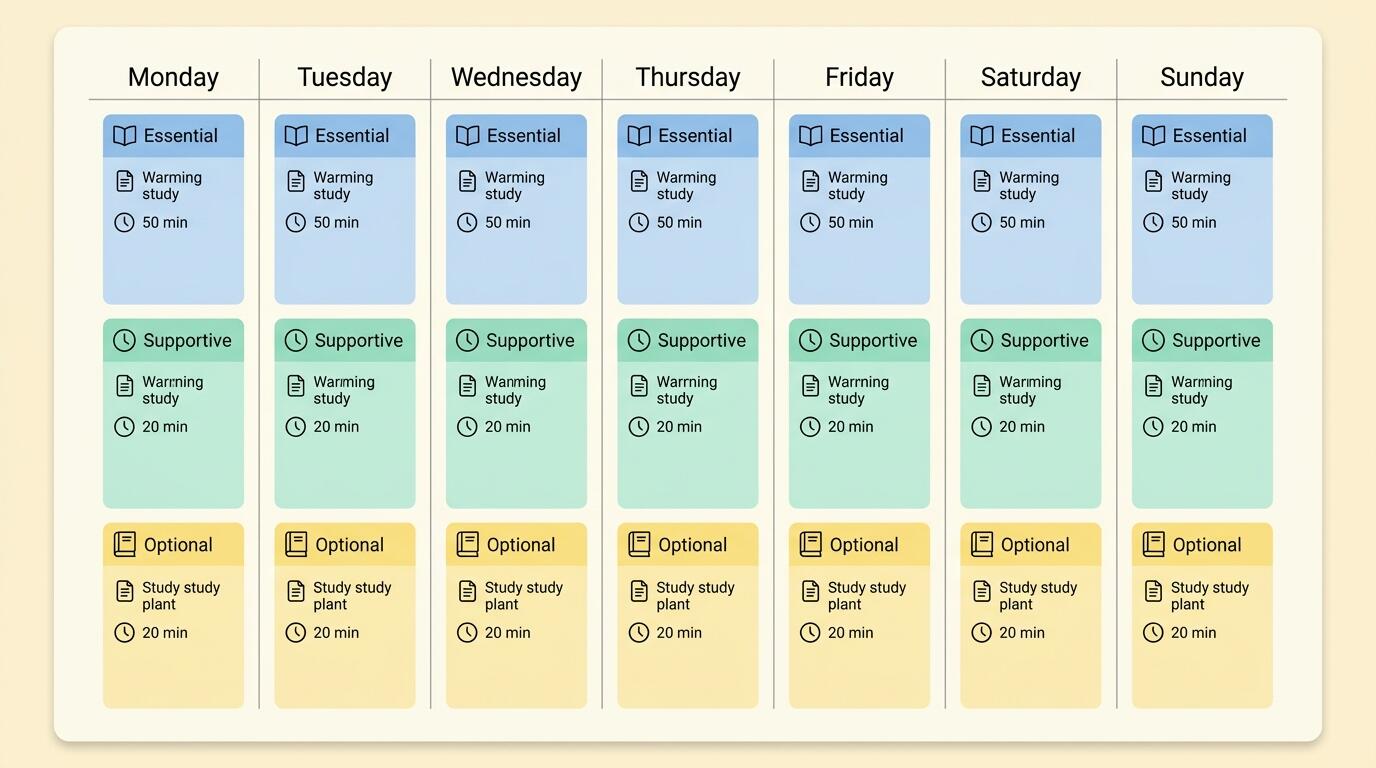
ALT: Weekly planner showing tiered reading priorities and study blocks for managing semester coursework
Pro Tips for Better Results
Students who sustain an effective prioritization system across a full semester tend to share a few habits beyond the basic steps above. First, separate reading for comprehension from reading for citation — if you know a source will be quoted in a paper, mark the exact passage during your first pass rather than searching for it again later. This alone saves significant rereading time when it comes to drafting.
Second, a common misconception is that skimming is a lesser or lazy form of reading. In reality, skimming is a legitimate and necessary strategy for background or optional-tier material, and reserving deep reading exclusively for essential-tier texts is what makes a heavy semester sustainable. Treating every assigned text as mandatory close reading is precisely what causes burnout and falling behind.
Third, build in buffer time before major deadlines rather than scheduling reading right up to the due date. Unexpected readings, illness, or extended office hours can all disrupt a tight schedule, and a buffer absorbs that disruption without cascading into missed work.
Fourth, when a reading directly feeds into a paper or research assignment, extracting notes and organizing them alongside your draft can meaningfully reduce the writing phase that follows. This is where a tool like Verla becomes useful — after you have prioritized and read your essential sources, Verla helps convert those notes and citations into submission-ready drafts, with automated citation generation across multiple styles so you are not manually reformatting references after the fact.
Finally, do not underestimate the value of talking to your instructor about which readings are truly essential versus supplementary. Office hours are an underused resource for confirming your prioritization decisions before you commit hours to the wrong material.
Frequently Asked Questions FAQ
Q1: How do I know which readings to prioritize when everything on the syllabus looks equally important?
Look at how each reading connects to graded work rather than its position on the syllabus. Readings tied to upcoming exams, papers, or presentations should rank above material included purely for background context. Cross-referencing your reading list against your assignment calendar, as described in Step 3, is the most reliable way to break ties between seemingly equal texts.
Q2: Is it acceptable to skip or only skim some assigned readings?
Yes, skimming optional or background-tier readings is a reasonable and widely used strategy, provided you have accurately classified which readings are truly essential to your assessments. The key risk is misjudging a reading’s importance, so recheck your tier assignments whenever you are uncertain, and confirm with your instructor if a specific text seems ambiguous in weight.
Q3: How much time should I budget per week for prioritized reading?
There is no universal number, since course load and reading density vary significantly by discipline and program level. Instead, base your weekly budget on your own realistic study capacity and adjust it during the regular recalibration checkpoints described in Step 7, increasing time for courses where you consistently fall behind on essential-tier material.
Wrapping Up
Prioritizing your reading list efficiently this semester comes down to three core practices: building a complete and honest inventory of every assigned text, tiering those readings by their actual contribution to your grades rather than their order on the syllabus, and scheduling your study time in a flexible, regularly reviewed structure rather than a rigid plan set in week one. Students who apply this system consistently report spending less time reading and more time genuinely understanding the material that matters for their coursework.
Your next step is simple: pull up every syllabus you have right now, build the master list described in Step 1, and block your first rolling reading schedule for the coming week. Once your essential readings are done and it is time to turn research and notes into a finished paper, that is where the writing process itself can become the new bottleneck.
Ready to make every assignment stress-free? Try Verla today at Verla and experience an AI academic assistant built on 10M+ scholarly texts—complete with humanization, citation generation, and in-browser editing to help you submit polished, ready-to-turn-in work in minutes.
Sources & Further Reading
- Taylor Pearson. “3 Steps to Prioritizing Your Reading List”.
https://taylorpearson.me/3-steps-to-prioritizing-your-reading/
- Next Big Idea Club. “13 Tips To Help You Conquer Your Reading List”.
https://nextbigideaclub.com/magazine/gretchen-rubin-13-tips-help-conquer-reading-list/6169/?srsltid=AfmBOoqHgCcrOajnB5Tk4-epfOFPPOc2E3r-32YCGfH-h70VJP245Y6x
- Pinereads Review. “Five Tips for Meeting Your Reading Goals During the School Year”.
Note: Standards may be updated; please check the latest official documents or consult professional advisors.
发表回复