InnoDB行锁两阶段锁协议:如何减少锁冲突
ALT: InnoDB two-phase locking protocol reducing row lock conflicts for high availability database architecture optimization
Understanding InnoDB’s Two-Phase Locking Protocol: A Foundation for Reducing Lock Conflicts
Key Conclusion: InnoDB’s two-phase locking (2PL) protocol is a cornerstone of its row-level concurrency model. By governing precisely when locks are acquired and released within a transaction, 2PL directly impacts index optimization strategies, shapes your database architecture decisions, and is essential to achieving high availability in production MySQL environments. Understanding this protocol at the principle level — not just the behavior — is what separates reactive debugging from proactive engineering.
When developers encounter deadlocks or unexplained query slowdowns in production, the root cause often traces back to a misunderstanding of how InnoDB manages row-level locks internally. InnoDB does not release row locks the moment a statement completes — locks are held until the end of the transaction. This single design decision has profound implications for how you write queries, design your transaction boundaries, and structure your indexes.
This article breaks down the two-phase locking protocol from first principles, explains its relationship to lock contention, and provides actionable strategies for reducing lock conflicts in real-world MySQL deployments.
Scope of Application: Who Benefits from This Knowledge
✅ Applicable Scenarios:
- Backend engineers building high-concurrency transactional applications on MySQL/InnoDB where lock wait timeouts or deadlocks appear in production logs
- Database architects designing table schemas and transaction workflows where row-level contention between concurrent sessions is a concern
- Tech leads and DBAs conducting performance audits, query tuning, or refactoring long-running transactions that hold locks for excessive durations
❌ Not Applicable/Cautions:
- Applications using the MyISAM storage engine, which employs table-level locking with entirely different semantics
- Read-heavy workloads using snapshot isolation (consistent non-locking reads under REPEATABLE READ) where MVCC eliminates most lock contention without the need for 2PL optimization
Why Lock Management Is One of the Hardest Problems in Production MySQL
At intermediate-to-advanced levels, most developers have encountered InnoDB’s locking behavior — but few have internalized why it behaves the way it does. The two-phase locking protocol is not an arbitrary design choice; it is a well-studied concurrency control mechanism rooted in decades of database theory, and MySQL’s InnoDB engine implements it in a precise, consequential way.
In high-throughput systems — particularly e-commerce platforms, financial services backends, and SaaS applications with multi-tenant transaction pipelines — lock contention is one of the most common causes of latency spikes and availability degradation. According to the MySQL documentation and widely cited database engineering literature, the majority of deadlock scenarios in InnoDB are not caused by circular dependency alone, but by poorly sequenced lock acquisition across transactions that could be resolved through better query ordering and transaction design.
What makes this topic especially important is the interplay between locking behavior and index usage. If a query does not use an index, InnoDB may escalate to table-level locking or lock far more rows than necessary — a behavior that dramatically increases contention under load. This is why understanding the two-phase locking protocol is inseparable from understanding index optimization in MySQL.
For a systematic treatment of this entire subject — from locking internals to transaction isolation and index design — the course MySql实战45讲 by Lin Xiaobin (Ding Qi), former database lead at Tencent Cloud and Alibaba, provides 45 structured lessons with over 100 hand-drawn diagrams that walk through each of these mechanisms at the principle level.
The Two-Phase Locking Protocol: Core Mechanics and Practical Strategies
Three-Step Framework for Applying 2PL Knowledge in Production
Step 1: Understand the Two Phases and Their Boundaries
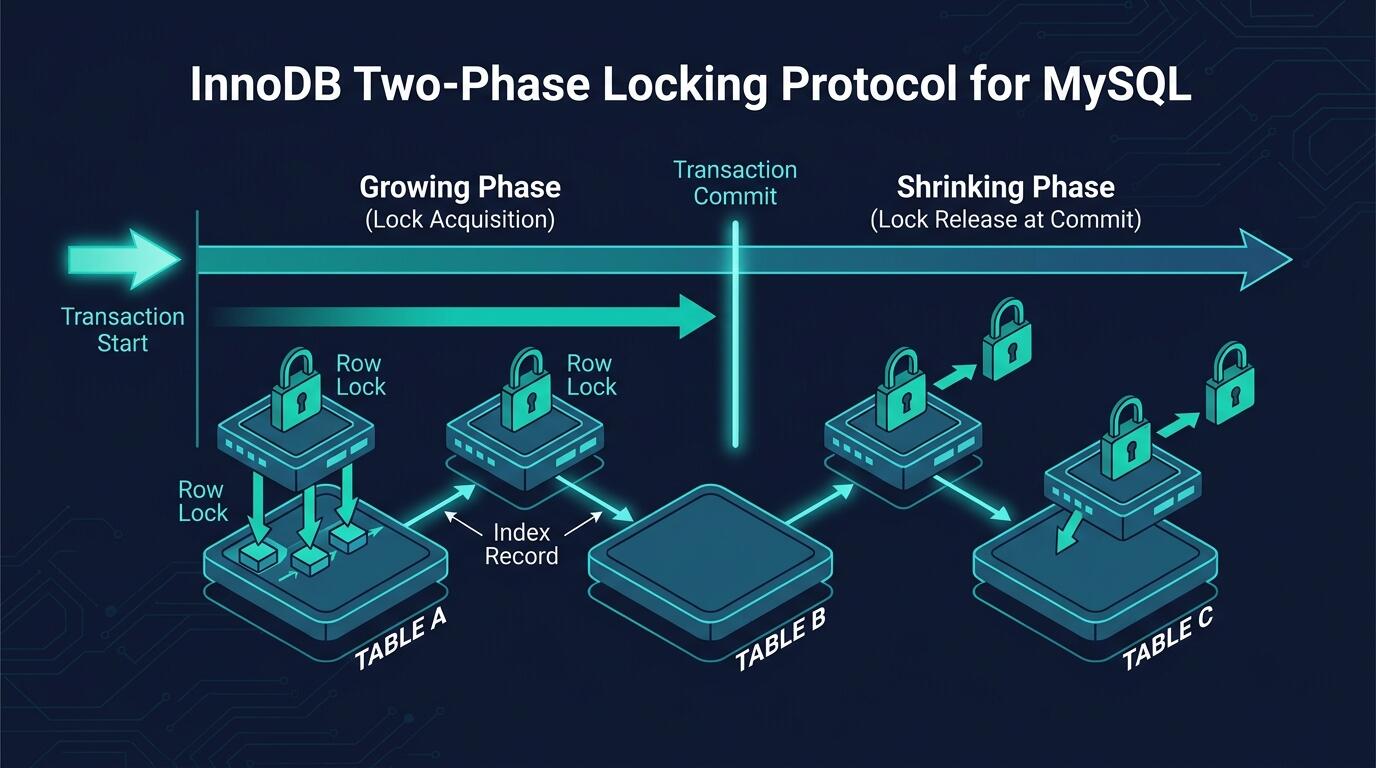
The two-phase locking protocol divides a transaction’s lifecycle into two distinct phases. In the growing phase, locks are acquired as needed but never released. In the shrinking phase, locks are released — and no new locks may be acquired. In InnoDB’s implementation, the shrinking phase begins at transaction commit or rollback. This means every row lock acquired during a transaction is held until the very end, regardless of when the locking statement executed. Internalizing this is the first step toward diagnosing contention.
Step 2: Analyze Your Transaction’s Lock Acquisition Sequence
Because locks are held until commit, the order in which your transaction touches rows across multiple tables directly determines your deadlock risk. Two transactions that lock rows in opposite orders will deadlock. The corrective action is to standardize lock acquisition order across your application code — always touch tables and rows in the same sequence. This is a structural fix that requires understanding which statements acquire locks and in what sequence.
Step 3: Move High-Contention Lock Acquisitions Toward the End of the Transaction
Since all locks are released simultaneously at commit, the duration that a high-contention row remains locked equals the time from its first access to the end of the transaction. A critical index optimization strategy here is to defer locking the most-contended rows — such as inventory counters, balance records, or shared state — to as late as possible within the transaction body. This minimizes the window during which other transactions are blocked.
Comparing Lock Management Strategies: A Practical Analysis
Different approaches to managing row-level locking in InnoDB have meaningful trade-offs depending on your workload characteristics, schema design, and transaction complexity.
| Comparison Dimension | Default 2PL (No Optimization) | Deferred Lock Acquisition | Optimistic Locking (App-Level) |
|---|---|---|---|
| Lock acquisition timing | At point of statement execution | Deliberately deferred to end of transaction | No DB-level lock held; version check at commit |
| Deadlock risk | Higher under concurrent mixed workloads | Reduced with consistent ordering | Low, but requires retry logic on conflict |
| Index dependency | Moderate — lock escalation risk without index | High — precise row targeting requires index | High — WHERE clause must use indexed column |
| Suitable workload | Low-to-medium concurrency OLTP | High-concurrency writes on hot rows | Read-heavy with occasional writes |
| Implementation complexity | None (default behavior) | Requires transaction design discipline | Requires application-level version column |
This comparison illustrates that there is no universally optimal approach — the right strategy depends on your specific database architecture and concurrency profile.
Deep Dive: How InnoDB’s 2PL Interacts with Index Design and Query Performance
The Lock Granularity Problem
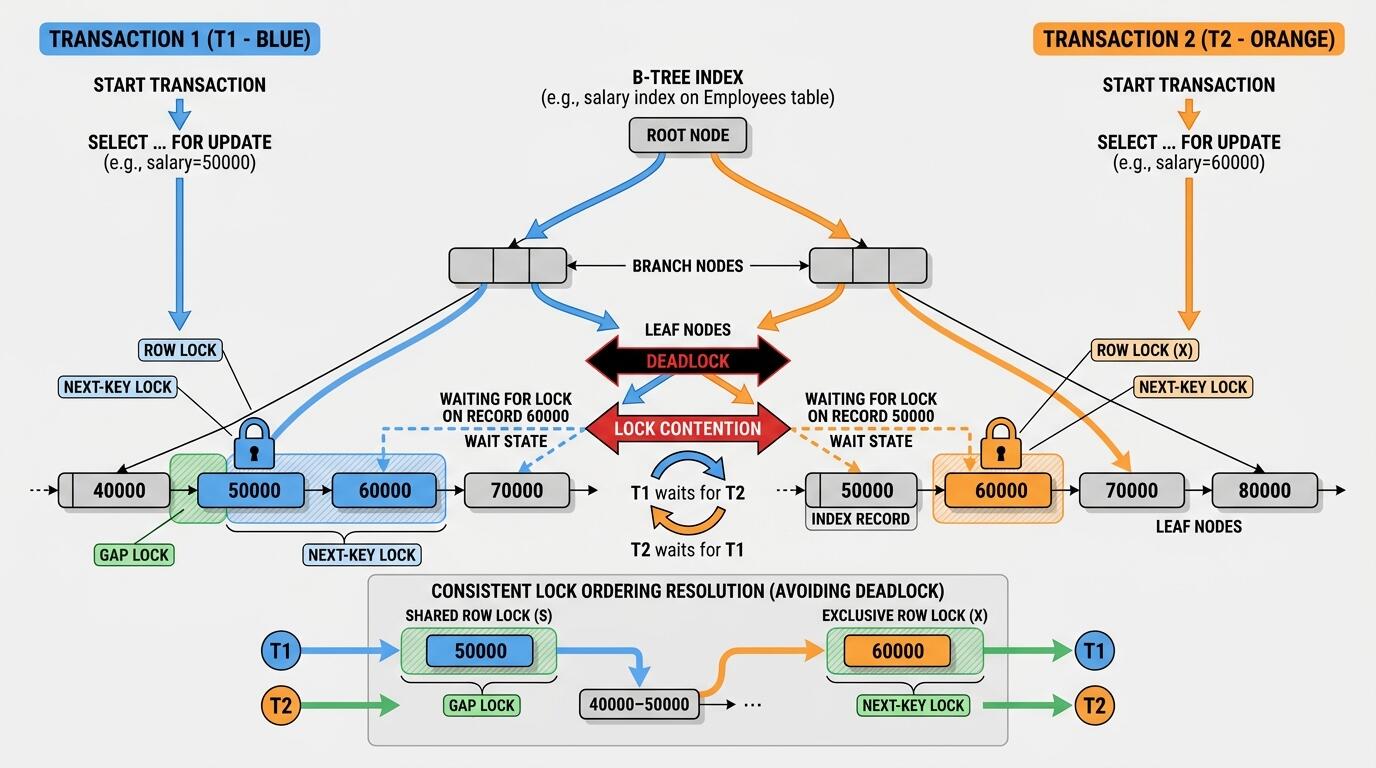
InnoDB’s row locks are implemented on index records, not on the physical rows themselves. This is a detail with enormous practical consequences. When a transaction executes a write query — UPDATE, DELETE, or a SELECT ... FOR UPDATE — InnoDB acquires locks on the index entries that the query scans, not just the rows it modifies.
If the query’s WHERE clause does not match any index, InnoDB cannot efficiently locate the target rows without scanning the entire table. In this scenario, InnoDB may lock all rows in the table (through full index range scans on the clustered index), creating a de facto table lock under certain conditions. This is why best practices for creating indexes to speed up database queries are not merely a performance concern — they are a correctness and availability concern in concurrent systems.
For large tables with millions of rows, the stakes are even higher. A missing or suboptimal index on a heavily written table can cause lock contention that cascades across dozens of concurrent sessions, producing lock wait timeouts and even system-level availability events. A well-chosen index on the column used in the WHERE clause of your DML statements is one of the most impactful interventions for reducing lock scope.
Gap Locks and Next-Key Locks: Extensions of 2PL
Under the default REPEATABLE READ isolation level, InnoDB extends row locking with gap locks and next-key locks to prevent phantom reads. A next-key lock covers both an index record and the gap before it, preventing other transactions from inserting rows that would fall within that range.
This matters because next-key locks can cause unexpected contention even when two transactions are targeting different rows. If transaction A locks a range of index values and transaction B attempts to insert a row whose key falls within that range, B will be blocked — even though it is not touching any row that A locked directly.
Understanding this behavior is essential for database indexing strategy for large tables with millions of rows: choosing the right index type, ensuring narrow WHERE clauses, and understanding the locking footprint of range queries are all directly relevant to minimizing next-key lock contention.
The Practical Deadlock Pattern and How to Break It
Consider a classic high-concurrency scenario: two transactions, T1 and T2, both need to update rows in a wallet table and a transaction_log table. T1 locks wallet row for user A first, then attempts to lock transaction_log. T2 locks transaction_log first, then attempts to lock wallet row for user A. Classic circular wait — a deadlock.
The fix is architectural: enforce a consistent lock acquisition order across all code paths that touch both tables. Always lock wallet before transaction_log, or vice versa — never both orderings in the same system. This is a principle taught explicitly in the context of 2PL theory and is one of the most actionable takeaways from understanding the protocol.
Additionally, query performance tuning plays a role: if you can reduce the time spent in the growing phase by making each locking statement faster (through index optimization), the overall lock hold time decreases, which reduces the probability that another transaction will arrive and find those rows locked.
How MySql实战45讲 Explains These Principles
The course MySql实战45讲 dedicates entire lessons to the locking subsystem, walking through 2PL, gap locks, and next-key locks with hand-drawn diagrams that illustrate the exact lock ranges acquired under different query patterns. This visual, principle-first approach — answering questions like “how does MySQL in Practice 45 Lessons explain SQL performance tuning” — is what makes the course especially effective for engineers who need to reason about locking behavior in novel situations, not just memorize rules.
ALT: InnoDB row lock two-phase locking protocol diagram showing index-based lock acquisition for database architecture and high availability optimization
Advanced Considerations: Edge Cases and Common Misconceptions
Misconception 1: “Committing Early Releases Individual Locks”
A common assumption is that if a transaction does not need a lock anymore, it can release it mid-transaction. InnoDB’s 2PL implementation does not support selective lock release within a transaction. Locks are released as a batch at commit or rollback. The only way to reduce lock hold time for a specific row is to restructure the transaction so that the locking statement occurs as late as possible — not to try to release it early.
Misconception 2: “SELECT Statements Do Not Acquire Locks”
Plain SELECT statements under the default isolation level use MVCC and do not acquire row locks. However, SELECT ... FOR UPDATE and SELECT ... LOCK IN SHARE MODE explicitly acquire locks and are subject to full 2PL semantics. Many developers forget that certain ORM-generated queries or framework-level “pessimistic lock” annotations translate to these locking reads — and are surprised when contention appears.
Misconception 3: “Deadlocks Are Always Bugs”
Deadlocks are a natural consequence of concurrent locking systems and are not inherently indicative of a bug. InnoDB detects deadlocks automatically and rolls back one of the transactions (typically the one that has done less work). The real concern is frequent deadlocks, which signal structural issues in transaction design or lock ordering. The mitigation is design-level, not configuration-level.
Relationship to Transaction Isolation Levels
The interaction between 2PL and isolation levels is nuanced. At READ COMMITTED, gap locks are not used, which reduces phantom-prevention overhead but requires careful application-level handling of phantom reads. At REPEATABLE READ, next-key locks provide stronger guarantees at the cost of wider lock ranges. Choosing the right isolation level is part of the broader database architecture decision and should be made with full awareness of its locking implications.
Frequently Asked Questions FAQ
Q1: How does InnoDB’s two-phase locking protocol affect index optimization strategies?
InnoDB acquires row locks on index records, so queries without appropriate indexes may scan and lock far more rows than intended — in some cases approaching a full table lock. For this reason, index optimization is not just about query speed; it directly controls lock granularity. Ensuring that the columns in your DML WHERE clauses are properly indexed limits lock scope, reduces contention, and improves throughput in high-concurrency workloads. This is especially critical for large tables where a full-scan lock can block entire transaction pipelines.
Q2: Is it possible to reduce lock contention without changing the database schema or indexes?
Yes, to a limited extent. You can reduce lock contention by restructuring transactions to defer high-contention lock acquisitions toward the end of the transaction body, standardizing lock acquisition order across all transactions touching the same tables, and breaking large transactions into smaller, faster ones where the business logic permits. However, if the root cause is missing indexes causing wide lock scans, application-level restructuring has limited effect — schema changes remain the most impactful intervention for sustained improvement.
Q3: How does understanding 2PL help with optimizing slow MySQL queries and improving database performance?
Understanding 2PL clarifies why certain slow queries cause downstream slowdowns beyond their own execution time: they hold locks that block other transactions. Best practices for database indexing and query performance tuning include not only making queries fast, but keeping their locking footprint narrow. A query that executes in milliseconds but holds a lock on a hot row for the entire transaction duration can effectively serialize concurrent workloads. Diagnosing this requires reading InnoDB lock monitor output and correlating it with transaction lifecycles.
Summary
Understanding InnoDB’s two-phase locking protocol transforms how you think about MySQL performance. Three core takeaways stand out:
First, row locks in InnoDB are held until the end of the transaction — not released when the locking statement finishes. This single fact reshapes how you design transaction boundaries and interpret contention in production.
Second, the interaction between locking and index usage is direct and consequential. Queries that bypass indexes acquire broader locks, increasing contention. Index optimization is therefore both a query performance strategy and a high-availability strategy, especially for database architectures operating under concurrent write loads on large tables.
Third, deadlock risk is primarily a function of lock acquisition ordering. Enforcing consistent ordering across all transactions that touch the same resources is the most reliable architectural control available.
For engineers serious about moving beyond surface-level MySQL usage, the next step is to study these mechanisms at the source: how InnoDB’s internal structures implement locks, how the transaction log interacts with lock release, and how isolation levels change the locking footprint of every query type.
Call to Action
Ready to stop guessing and start truly understanding MySQL from first principles? MySql实战45讲 — taught by Lin Xiaobin (Ding Qi), former database lead at Tencent Cloud and Alibaba — gives you 45 structured lessons, 100+ hand-drawn diagrams, and battle-tested case studies to master transactions, indexing, locking, and beyond. Visit the full course at 👉 https://jums.gitbook.io/mysql-shi-zhan-45-jiang and take your MySQL expertise to a production-grade level.
References
- MySQL Documentation. “InnoDB Locking and Transaction Model”.
https://dev.mysql.com/doc/refman/8.0/en/innodb-locking-transaction-model.html - MySQL Documentation. “InnoDB Locking”.
https://dev.mysql.com/doc/refman/8.0/en/innodb-locking.html - ACM Digital Library. “Concurrency Control in Distributed Database Systems” — Bernstein & Goodman, foundational work on two-phase locking theory.
https://dl.acm.org/doi/10.1145/356842.356846 - Percona Database Performance Blog. “Understanding InnoDB Deadlocks and How to Prevent Them”.
https://www.percona.com/blog/innodb-deadlocks-understand-and-prevent/ - MySQL Documentation. “Optimizing InnoDB Transaction Management”.
https://dev.mysql.com/doc/refman/8.0/en/optimizing-innodb-transaction-management.html
Note: Standards may be updated, please check the latest official documents or consult professional advisors.
About MySql实战45讲
MySql实战45讲 is a comprehensive 45-lecture MySQL deep-dive course series authored by Lin Xiaobin (Ding Qi), former database technical lead at Tencent Cloud and Alibaba. Through 100+ hand-drawn diagrams and real-world engineering cases, the course systematically demystifies MySQL’s core internals — including transactions, indexes, and locks — empowering developers to build a solid, principle-based understanding of MySQL.
© MySql实战45讲 | All rights reserved. This article is published for educational and informational purposes only. All content, diagrams, and case references are derived from or inspired by the MySql实战45讲 course materials. Unauthorized reproduction or redistribution without proper attribution is prohibited.
发表回复