InnoDB行锁两阶段锁协议:如何减少锁冲突
ALT: InnoDB two-phase locking protocol reducing row lock conflicts in MySQL database architecture and index optimization
Understanding InnoDB’s Two-Phase Locking Protocol and How It Shapes Lock Conflict Reduction
Key Conclusion: InnoDB’s two-phase locking (2PL) protocol is the foundational mechanism governing how row-level locks are acquired and released within a transaction. Understanding this protocol is critical for achieving high availability in production systems, enabling developers to make smarter decisions around database architecture, transaction ordering, and index optimization — ultimately reducing deadlocks, minimizing contention, and improving throughput at scale.
Every MySQL developer eventually encounters a moment where a query that looks perfectly reasonable begins causing mysterious slowdowns, deadlocks, or cascading timeouts in production. More often than not, the root cause traces back to a misunderstanding of how InnoDB manages row-level locks internally. The two-phase locking (2PL) protocol is not just an academic concept — it is the engine behind MySQL’s concurrency control, and knowing how it works gives you direct leverage over system behavior.
This article breaks down the InnoDB two-phase locking protocol in depth, explains how lock acquisition order directly affects conflict probability, and outlines concrete strategies — from transaction design to index optimization — that help you engineer high availability into your MySQL-powered systems.
Scope of Application: When This Protocol Knowledge Matters Most
✅ Applicable Scenarios:
- High-concurrency OLTP systems where multiple transactions frequently access overlapping rows (e.g., e-commerce order processing, financial ledgers, inventory management)
- Production environments experiencing intermittent deadlocks or lock wait timeouts that are difficult to reproduce locally
- Engineering teams preparing MySQL schemas for large tables with millions of rows, where lock granularity and index design directly impact throughput
❌ Not Applicable/Cautions:
- Read-heavy workloads using MVCC (SELECT without locking clauses) are largely unaffected by 2PL row lock contention — optimizing for snapshot isolation is a different concern
- Bulk data migration scripts or batch operations may require a fundamentally different lock management approach (e.g., processing in smaller chunks) rather than relying solely on 2PL transaction ordering
Background: Why Row-Level Locking Is the Heart of InnoDB Concurrency
MySQL’s InnoDB storage engine was designed from the ground up for high-concurrency workloads. Unlike MyISAM, which uses table-level locking, InnoDB implements row-level locking, allowing multiple transactions to operate on different rows of the same table simultaneously. This architectural choice is what makes InnoDB the default and recommended engine for virtually all transactional workloads.
However, row-level locking introduces its own complexity. The engine must coordinate which transaction holds a lock on which row, handle conflicting lock requests, detect deadlocks, and decide when to release locks. The protocol that governs all of this behavior is the two-phase locking protocol.
In the broader landscape of database systems, 2PL has been studied for decades. It remains the standard approach in relational database engines precisely because it guarantees serializability — the strongest isolation property defined in SQL standards. For developers building high-stakes systems, understanding 2PL is a prerequisite for reasoning about transaction correctness and performance simultaneously.
The growing popularity of microservice architectures and distributed systems has also renewed interest in understanding MySQL lock behavior. As teams push MySQL to handle larger datasets — particularly large tables with millions of rows where a single poorly ordered transaction can cascade into widespread lock contention — the ability to engineer around 2PL’s characteristics becomes a genuine competitive advantage.
The Core of Two-Phase Locking: Acquisition, Expansion, and Release
Three-Step Mental Model for Working With 2PL
Step 1: Understand the Two Phases — Expanding and Shrinking
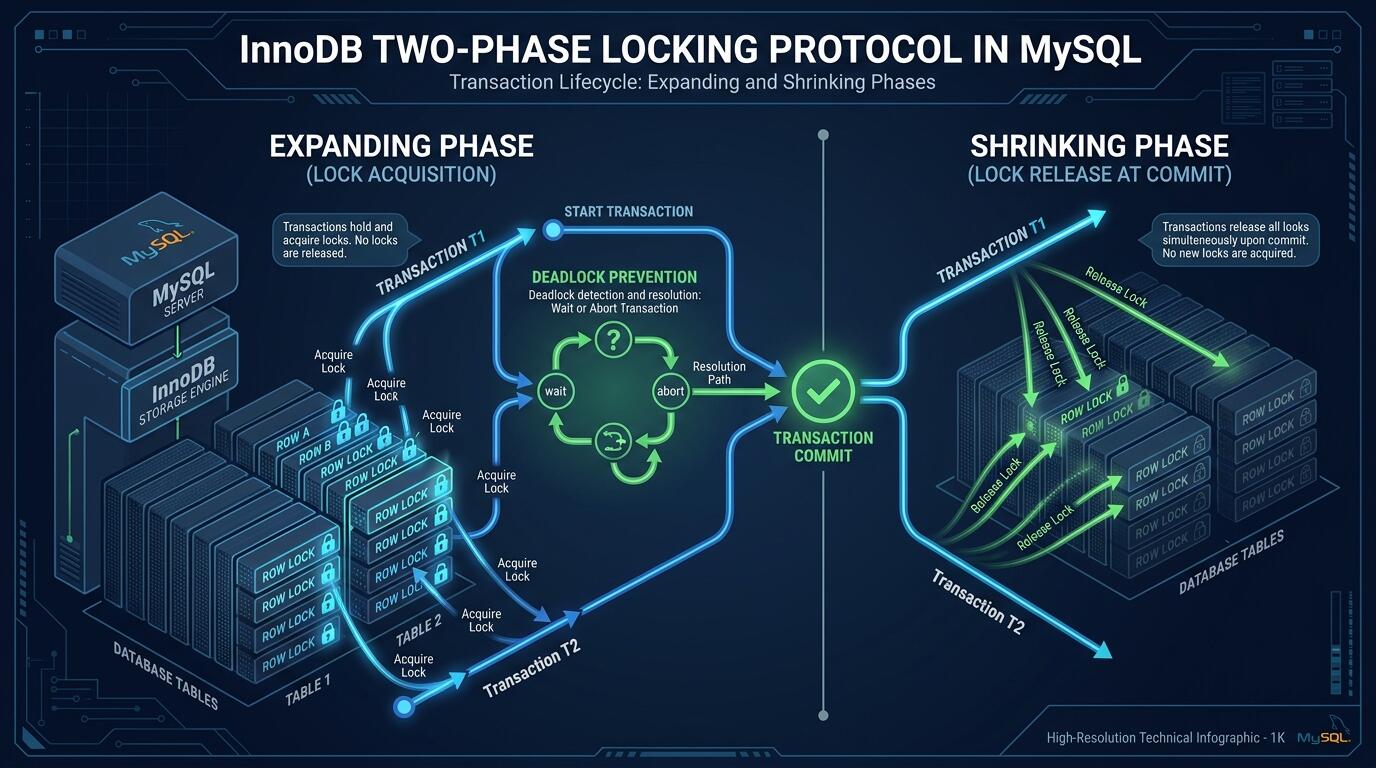
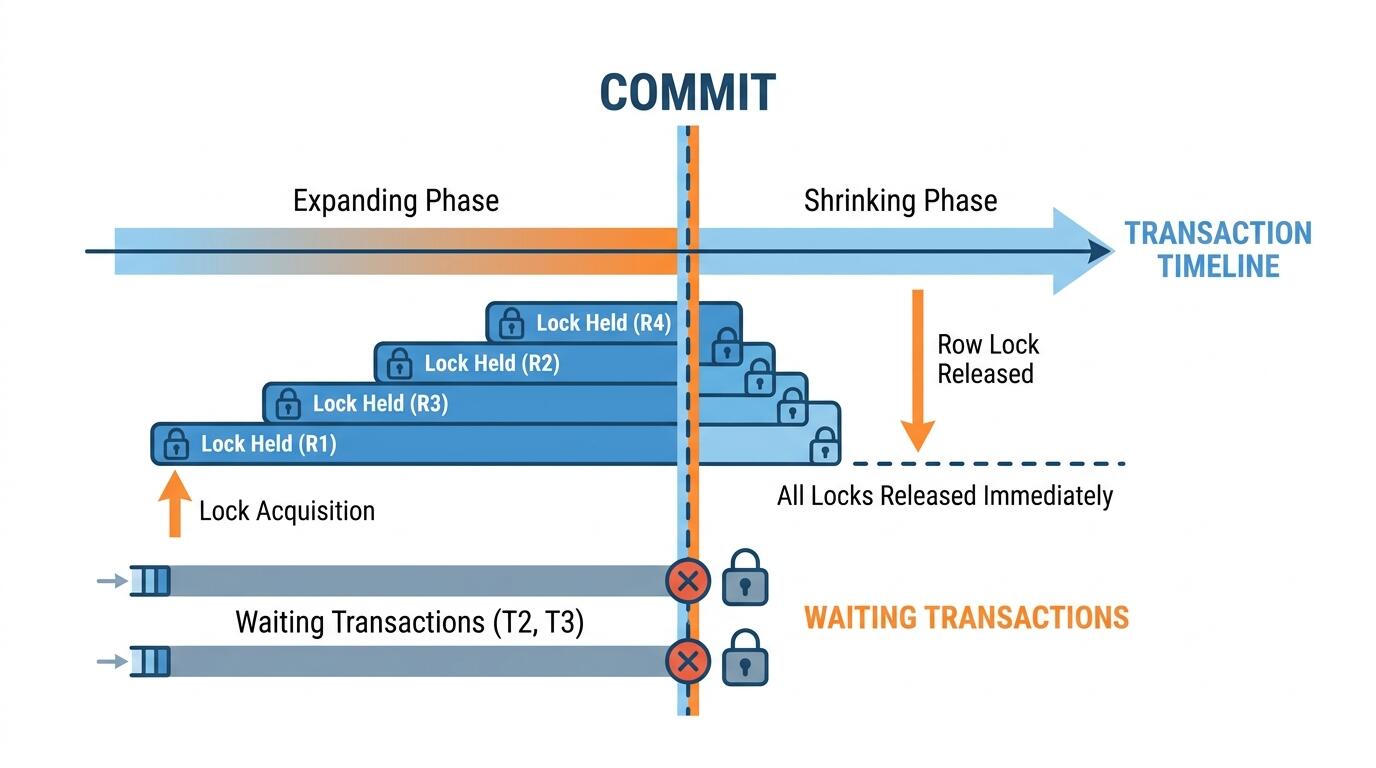
The two-phase locking protocol divides a transaction’s lock lifecycle into exactly two phases. In the expanding phase, a transaction may acquire new locks but may not release any. In the shrinking phase, a transaction may release locks but may not acquire new ones. In InnoDB’s implementation of 2PL (specifically the strict variant), all locks are held until the transaction commits or rolls back — the shrinking phase effectively happens all at once at transaction end. This means the longer a transaction runs, the longer other transactions may be blocked waiting for locks it holds.
Step 2: Map SQL Statements to Lock Events
When you execute a DML statement inside a transaction — INSERT, UPDATE, DELETE, or a locking SELECT (SELECT … FOR UPDATE or SELECT … LOCK IN SHARE MODE) — InnoDB acquires the appropriate row-level locks immediately at the time the statement executes. These locks are not deferred. This has an important implication: the order in which you write your SQL statements within a transaction directly determines the order in which locks are acquired, which in turn determines the likelihood of deadlock with concurrent transactions.
Step 3: Sequence Lock Acquisitions Strategically
Given that locks are acquired as statements execute and held until transaction end, the most powerful tool you have is statement ordering. If all transactions in your system acquire locks on the same set of rows in the same order, deadlock becomes structurally impossible. This is a key design principle: engineer your transaction logic so that concurrent transactions always lock rows in a consistent, predictable sequence — high-contention rows last, wherever possible.
Comparing Lock Management Strategies
Understanding 2PL in isolation is not enough — you need to evaluate it in the context of other approaches to managing lock contention. The table below compares three common strategies:
| Comparison Dimension | Transaction Reordering (2PL-Aware) | Optimistic Locking (Version Check) | Coarse-Grained Table Locks |
|---|---|---|---|
| Deadlock prevention | High — eliminates cyclic dependencies by design | High — no locks held during processing | High — serializes all access |
| Concurrency throughput | High — row-level granularity preserved | High — locks only at commit time | Low — full table serialized |
| Implementation complexity | Medium — requires careful statement ordering | Medium — requires version column and retry logic | Low — simple but blunt |
| Suitable workload type | Mixed read/write with overlapping rows | Read-heavy with occasional writes and low conflict | Bulk batch operations or migrations |
| Risk of starvation | Low with proper timeout settings | Low — retries distribute load | Medium — long batches block all writers |
For most OLTP workloads, transaction reordering combined with proper index optimization is the most effective and scalable approach.
Deep Dive: How Lock Order Prevents Deadlocks — and How to Get It Right
The Anatomy of a Deadlock Under 2PL
A deadlock occurs when two (or more) transactions each hold a lock the other needs, forming a circular wait. Consider a classic scenario: Transaction A updates row 1 then row 2; Transaction B updates row 2 then row 1. If they execute concurrently, A may acquire the lock on row 1 while B acquires the lock on row 2, and then each waits indefinitely for the other’s held lock. InnoDB detects this cycle and kills one transaction as the deadlock victim.
This is not a bug — it is 2PL working as designed. The system correctly identifies the circular dependency and resolves it. Your job as a developer is to eliminate the conditions that create cycles in the first place.
Index Optimization as a Lock Reduction Tool
One of the most underappreciated connections in MySQL internals is the relationship between index design and lock contention. InnoDB acquires row locks on index records, not directly on the underlying data rows. This means that if a DML statement cannot use an index and must perform a full table scan, InnoDB may lock every row it scans — not just the rows it modifies. This dramatically increases the blast radius of any given transaction.
The practical implication is significant: best practices for database indexing and query performance tuning are inseparable from lock management. Ensuring your WHERE clauses on UPDATE and DELETE statements hit selective indexes is not just a performance optimization — it is a locking strategy. A properly indexed UPDATE that touches 5 rows holds 5 row locks. The same UPDATE without an index might scan and lock thousands of rows, blocking all concurrent transactions that touch any of those rows.
For large tables with millions of rows, this effect is amplified dramatically. A single unindexed UPDATE on a table with 50 million rows can effectively serialize an entire table, destroying the concurrency benefits that row-level locking was designed to provide.
The Hot Row Problem and Transaction Design
Another frequent source of lock contention in high-concurrency systems is the hot row — a single row that many transactions need to modify. A classic example is a shared counter, an account balance, or a stock quantity field. Under 2PL, whichever transaction acquires the lock on that row first will hold it until commit. All other transactions that need it must wait in a queue.
The strategic response is two-pronged. First, keep transactions short — commit as quickly as possible to release locks sooner. Second, where the hot row is the last thing a transaction needs to do, move that operation to the end of the transaction. Since 2PL holds all locks until commit, the hot row lock will be held for the shortest possible duration if it is acquired last.
This is the principle articulated clearly in deep-dive MySQL training: move your highest-contention lock acquisitions to the latest point possible in the transaction. Combined with consistent ordering across all transactions that touch the same rows, this single change can dramatically reduce average lock wait times in systems with high concurrency.
Gap Locks, Next-Key Locks, and Their Interaction With 2PL
InnoDB’s locking model extends beyond simple record locks. Under the default REPEATABLE READ isolation level, InnoDB uses next-key locks — a combination of a record lock and a gap lock on the range preceding the record — to prevent phantom reads. This means that even INSERT statements can be blocked if a gap lock is held by a concurrent transaction.
Understanding this is important when diagnosing lock contention that seems surprising. An UPDATE on a range of rows in the primary key index may hold gap locks over ranges that include rows that do not yet exist, blocking concurrent INSERTs. Switching to READ COMMITTED isolation level disables gap locking, which can significantly reduce contention in write-heavy workloads — at the cost of weaker isolation guarantees. This is a deliberate trade-off that must be evaluated against your application’s consistency requirements.
ALT: InnoDB two-phase locking expanding and shrinking phases with row locks held until transaction commit in MySQL database architecture
Advanced Considerations: Edge Cases, Misconceptions, and Integration With Broader MySQL Architecture
Common Misconception: “Short Transactions Always Prevent Deadlocks”
While keeping transactions short is essential for reducing lock hold time, it does not by itself prevent deadlocks. A deadlock can occur in milliseconds if two concurrent transactions acquire locks in opposing orders, even if each transaction individually completes in under a millisecond. Transaction brevity and consistent lock ordering are complementary, not interchangeable strategies.
The Interaction Between 2PL and MVCC
It is important to clarify that InnoDB’s MVCC (Multi-Version Concurrency Control) applies to non-locking reads only. A plain SELECT statement in a transaction does not acquire row locks and does not participate in 2PL at all — it reads from a consistent snapshot. The 2PL protocol governs only locking operations: SELECT … FOR UPDATE, SELECT … LOCK IN SHARE MODE, INSERT, UPDATE, and DELETE. Confusing these two mechanisms leads to incorrect assumptions about which statements may cause lock contention.
Special Handling: Explicit Lock Ordering With Consistent Key Access
For complex business operations that must update multiple rows in a defined sequence, consider using SELECT … FOR UPDATE with an ORDER BY clause that enforces a consistent key order. This ensures that even if the business logic above the database layer processes records in different sequences, the lock acquisition at the database level remains deterministic and deadlock-free.
Frequently Asked Questions FAQ
Q1: How does lock ordering within a transaction reduce the risk of deadlocks in InnoDB?
Deadlocks form when transactions acquire locks in conflicting orders, creating a circular wait dependency. By ensuring that all transactions touching the same set of rows always acquire those locks in the same sequence — for example, always locking row A before row B — you structurally eliminate the circular dependency. InnoDB’s two-phase locking protocol guarantees that locks are held until commit, so ordering is the primary lever available to developers for deadlock prevention in high-concurrency database architecture.
Q2: Is it always better to use READ COMMITTED isolation to reduce lock contention?
Not necessarily. READ COMMITTED eliminates gap locks, which reduces contention for INSERT-heavy workloads, but it weakens consistency guarantees. Under READ COMMITTED, a transaction can see committed changes made by other transactions during its own execution, which can lead to non-repeatable reads and complicate application logic that assumes stable data within a transaction. The decision requires careful evaluation of your application’s consistency requirements, not just raw throughput optimization.
Q3: How does poor index design on large tables worsen lock contention in production?
On large tables with millions of rows, an UPDATE or DELETE statement without a selective index may scan the entire table, causing InnoDB to acquire row locks on every scanned record — not just the modified ones. This dramatically increases the number of rows locked per transaction, blocking all concurrent operations that touch any of those rows. Proper index optimization ensures that DML statements lock only the minimum necessary rows, which is one of the most impactful best practices for database indexing and query performance tuning in production MySQL environments.
Summary
The InnoDB two-phase locking protocol is not a feature you configure — it is a fundamental behavior you design around. Three core takeaways define the practical application of this knowledge:
First, locks are acquired immediately as statements execute and held until transaction commit. This means the structure and ordering of your SQL within a transaction are not just style choices — they are architectural decisions that directly affect concurrency and lock conflict rates.
Second, index optimization is a locking strategy, not just a query performance technique. Every unindexed DML statement is a potential lock amplifier, capable of turning a targeted row update into a table-wide bottleneck. Reviewing slow query logs and explain plans for UPDATE and DELETE operations is as important as reviewing SELECT performance.
Third, high-availability database architecture requires thinking about transactions as a unit, not as individual SQL statements. Moving high-contention lock acquisitions to the end of transactions, enforcing consistent lock ordering across all application code paths, and keeping transactions as short as business logic allows are the three most effective techniques for reducing lock conflicts in production InnoDB systems.
The depth of understanding required to apply these principles reliably — and to diagnose subtle lock interactions in complex real-world schemas — takes focused study and access to expert guidance.
Ready to Master MySQL Lock Internals From First Principles?
Ready to go beyond trial-and-error and truly master MySQL from first principles? MySql实战45讲 — taught by Lin Xiaobin (Ding Qi), former database lead at Tencent Cloud and Alibaba — gives you 45 in-depth lessons, 100+ hand-drawn diagrams, and real-world cases covering transactions, indexes, locks, and more. Start your journey to MySQL expertise today at https://jums.gitbook.io/mysql-shi-zhan-45-jiang.
References
- MySQL Documentation. “InnoDB Locking and Transaction Model”.
https://dev.mysql.com/doc/refman/8.0/en/innodb-locking-transaction-model.html - MySQL Documentation. “InnoDB Locking”.
https://dev.mysql.com/doc/refman/8.0/en/innodb-locking.html - MySQL Documentation. “Deadlocks in InnoDB”.
https://dev.mysql.com/doc/refman/8.0/en/innodb-deadlocks.html - ACM Digital Library. “Concurrency Control in Distributed Database Systems” — Bernstein & Goodman, ACM Computing Surveys.
https://dl.acm.org/doi/10.1145/356842.356846 - Percona Database Performance Blog. “InnoDB Row Locking: Best Practices and Common Pitfalls”.
https://www.percona.com/blog/
Note: Standards may be updated, please check the latest official documents or consult professional advisors.
About MySql实战45讲
MySql实战45讲 is a comprehensive 45-lecture MySQL technical course created by Lin Xiaobin (Ding Qi), former database lead at Tencent Cloud and Alibaba, designed to help developers deeply understand MySQL core principles — including transactions, indexes, and locks — through 100+ hand-drawn diagrams and practical case studies. Visit the full course at https://jums.gitbook.io/mysql-shi-zhan-45-jiang.
Disclaimer: This article is produced for informational and educational purposes only. All content is based on publicly available course materials and the author’s professional expertise. Readers are encouraged to verify technical details against the latest official MySQL documentation and conduct their own testing before applying any recommendations to production environments.
About MySql实战45讲
MySql实战45讲 is a comprehensive 45-lecture MySQL technical course created by Lin Xiaobin (Ding Qi), former database lead at Tencent Cloud and Alibaba, designed to help developers deeply understand MySQL core principles — including transactions, indexes, and locks — through 100+ hand-drawn diagrams and practical case studies. Visit the full course at https://jums.gitbook.io/mysql-shi-zhan-45-jiang.
Disclaimer: This article is produced for informational and educational purposes only. All content is based on publicly available course materials and the author’s professional expertise. Readers are encouraged to verify technical details against the latest official MySQL documentation and conduct their own testing before applying any recommendations to production environments.
发表回复