MySQL WAL机制与组提交:如何提升IO写入性能
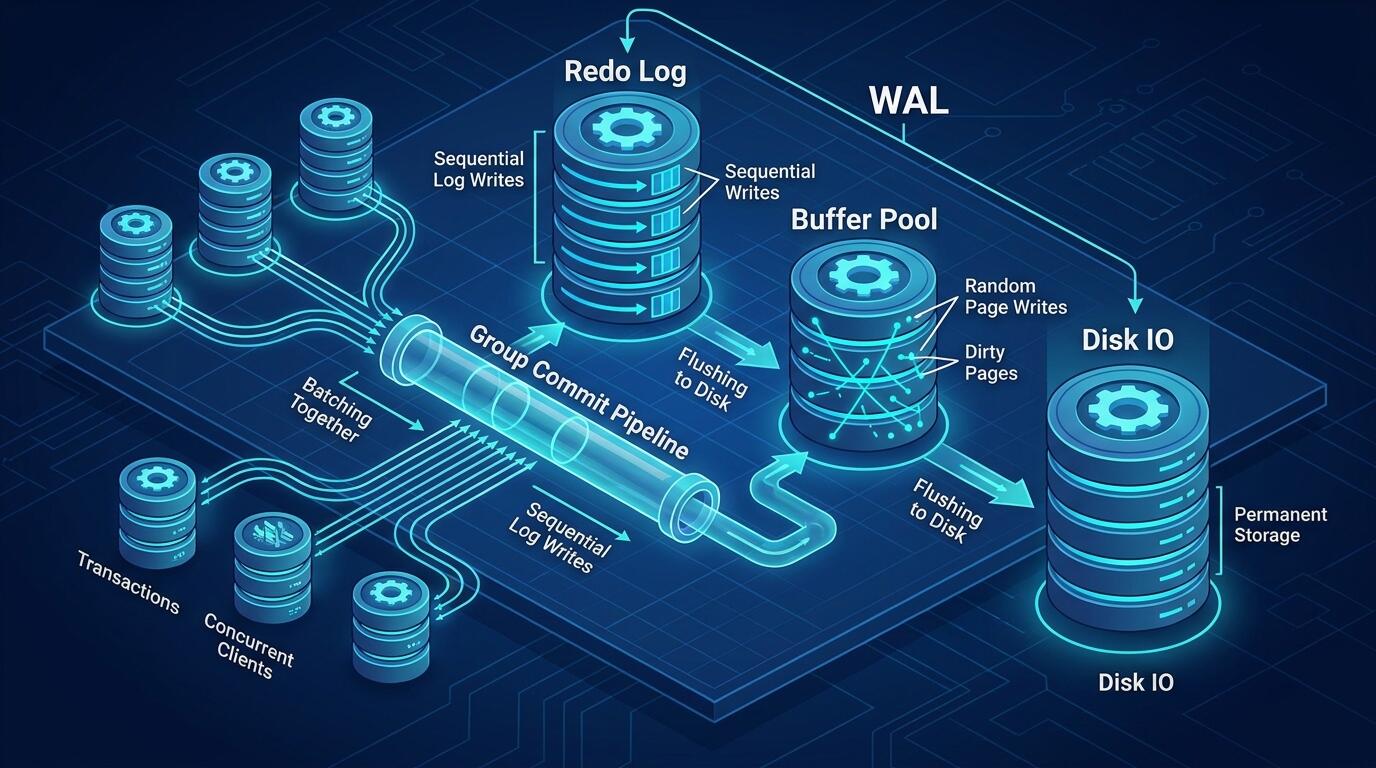
ALT: MySQL WAL mechanism and group commit improving IO write performance and database performance
How MySQL’s WAL Mechanism and Group Commit Supercharge Your IO Write Performance and Database Performance
Every backend engineer has faced it: a write-heavy workload that grinds MySQL to a halt, transaction latency climbing, and disk IO becoming the unmistakable bottleneck. The question at the heart of this problem is deceptively simple — how does MySQL guarantee data durability without sacrificing write throughput? The answer lies in two tightly coupled mechanisms: the Write-Ahead Log (WAL) and group commit. Understanding these internals is not just academic; it is the foundation of effective query performance tuning and sql optimization for any production system under real load.
This guide is written for software developers and backend engineers who already understand basic MySQL operations and want to advance to a principle-level understanding of how MySQL manages IO. It is equally relevant for database administrators, tech leads, and engineers preparing for technical interviews at top-tier companies where deep MySQL knowledge is expected.
Before You Start: Prerequisites and Preparation for Understanding MySQL IO Performance
Before diving into WAL and group commit, it helps to arrive with a clear mental model of what MySQL’s storage layer looks like. These mechanisms live at the intersection of InnoDB’s buffer pool, the redo log, and the binary log — so familiarity with each concept will make the explanations click faster.
In our work with developers studying MySQL internals, a consistent pattern emerges: engineers who struggle with IO performance tuning almost always lack a clear picture of the commit pipeline. This guide is designed to close that gap systematically.
Time and effort: The conceptual sections are approachable in a single focused reading session. Applying the tuning steps to a real system will take additional experimentation, depending on your workload profile.
✅ Checklist before starting:
- Familiarity with InnoDB as MySQL’s default storage engine
- Basic understanding of what a transaction is and what ACID guarantees mean
- Awareness that MySQL uses two distinct log files: the redo log (InnoDB) and the binary log (server layer)
- Access to a MySQL instance where you can inspect or modify system variables
- Foundational knowledge of Linux disk IO concepts (fsync, page cache, buffered writes)
- An understanding of why
innodb_flush_log_at_trx_commitandsync_binlogare critical durability parameters
Step-by-Step: Mastering MySQL WAL and Group Commit for Superior IO Write Performance
Step 1: Understand Why Naive Disk Writes Kill Database Performance
To appreciate WAL, you first need to feel the pain it solves. In a naive transactional database, every commit would require writing the modified data pages directly to their random positions on disk before acknowledging success to the client. On a spinning disk, random writes are orders of magnitude slower than sequential writes. Even on SSDs, random write amplification and fsync overhead accumulate quickly under concurrent load.
The fundamental problem is that data pages are scattered across the tablespace — a single transaction might touch dozens of non-contiguous pages. Flushing all of them synchronously on every commit is catastrophically expensive.
Tip: This is why understanding the physical layout of data on disk is inseparable from sql optimization. Surface-level query tuning can only take you so far; real throughput gains come from understanding how writes are actually committed.
Step 2: Grasp the WAL Principle — Sequential Writes as a Performance Foundation
Write-Ahead Logging solves the random-write problem with an elegant principle: before modifying data pages in place, first write a description of the change to a sequential log file. This log — InnoDB’s redo log — is written sequentially, which is dramatically faster than random page writes regardless of storage medium.
The WAL contract is straightforward: as long as the redo log record for a transaction is durably written to disk before the commit is acknowledged, the database can guarantee that the change can be recovered even if the data page itself has not yet been flushed. On crash recovery, InnoDB replays the redo log to bring data pages back to a consistent state.
This is the core of how MySQL achieves both durability and write performance simultaneously. The data page flush can be deferred and batched — a process called checkpointing — while the redo log write is the only mandatory synchronous operation on the commit path.
Tip: When you see innodb_flush_log_at_trx_commit=1 in a production configuration, you are looking at the WAL durability guarantee in action. This setting ensures the redo log is fsynced to disk on every commit, which is the safest and most ACID-compliant mode.
Step 3: Trace the Full Two-Phase Commit Pipeline
MySQL’s commit pipeline is more complex than a single log write because InnoDB must coordinate two separate logs: the redo log and the binary log. The binary log is used for replication and point-in-time recovery, and it lives at the MySQL server layer, above InnoDB. This creates a classic distributed commit problem: how do you ensure both logs are consistent with each other?
MySQL solves this with a two-phase commit (2PC) protocol:
Phase 1 — Prepare: InnoDB writes a prepare record to the redo log and fsyncs it. At this point, the transaction is “prepared” but not yet committed.
Phase 2 — Commit: The server writes the transaction’s events to the binary log and fsyncs it. InnoDB then writes a commit record to the redo log.
If a crash occurs between the prepare and the binary log write, the transaction is rolled back on recovery. If a crash occurs after the binary log write but before the InnoDB commit record, the transaction is committed on recovery (because the binary log is the source of truth for replication). This two-phase structure guarantees that the redo log and binary log never diverge.
Understanding this pipeline is essential for anyone doing serious database performance work, because every fsync in this sequence has a cost — and that cost is multiplied by every concurrent transaction.
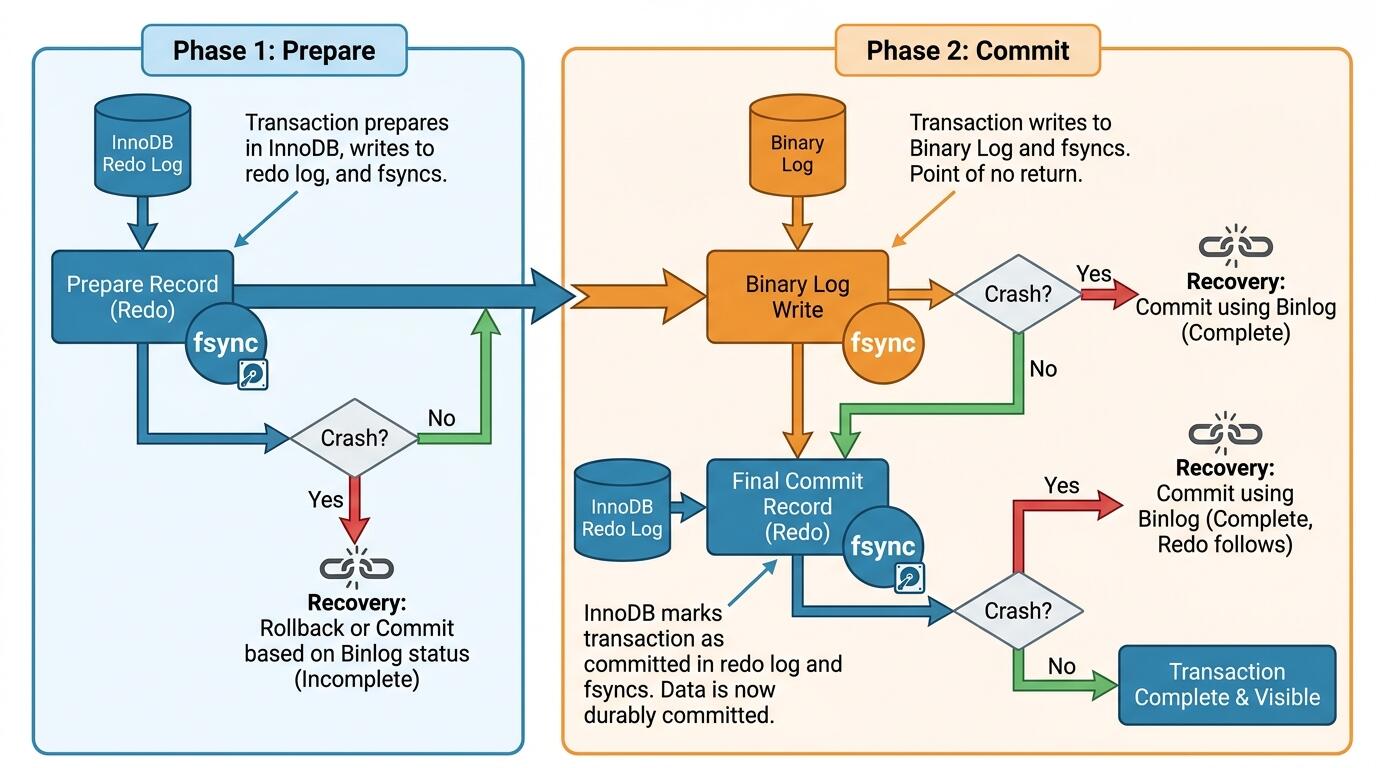
ALT: MySQL two-phase commit pipeline showing redo log prepare, binary log write, and InnoDB commit for database performance optimization
Tip: In our experience reviewing production configurations, a common source of unexpected latency is having sync_binlog=1 and innodb_flush_log_at_trx_commit=1 without understanding that each transaction triggers multiple fsync calls. This is correct for full durability, but the IO cost is real and must be accounted for in capacity planning.
Step 4: Recognize the Group Commit Optimization
Here is where MySQL’s IO write performance takes a significant leap. The insight behind group commit is this: if multiple transactions are waiting to commit at roughly the same time, there is no reason to issue a separate fsync for each one. Instead, MySQL can batch them together, write all their log records in a single sequential write, and issue a single fsync that covers all of them simultaneously.
This is group commit. It transforms N individual fsyncs into a single fsync that amortizes the IO cost across all N transactions. The throughput improvement under concurrent write load can be dramatic — the more concurrent writers, the greater the benefit.
InnoDB’s redo log group commit works by organizing concurrent commits into a queue. The first transaction to arrive becomes the “leader” of the group; subsequent transactions that arrive while the leader is preparing the write become “followers.” The leader performs the write and fsync on behalf of the entire group, then signals all followers that their commits are complete.
Tip: Group commit is most effective when there is genuine concurrency — multiple transactions committing at overlapping times. A single-threaded workload that commits transactions serially will see little benefit. This is why benchmarking write performance with realistic concurrency levels is critical for accurate capacity planning.
Step 5: Understand Binary Log Group Commit (BLGC) and Its Three-Stage Pipeline
MySQL extended group commit to the binary log as well, introducing Binary Log Group Commit (BLGC). This is a particularly important optimization because the binary log fsync was historically a serialization point that limited write throughput even when InnoDB’s redo log group commit was working well.
BLGC organizes the commit process into three explicit stages, each with its own queue:
Flush stage: Transactions write their binary log events to the binary log buffer. The leader flushes the buffer to the binary log file.
Sync stage: The binary log file is fsynced to disk. All transactions that completed the flush stage together share this single fsync.
Commit stage: InnoDB commits are performed in the order established by the binary log sequence. This ordering is critical for replication consistency.
The key insight is that while one group is in the sync stage (waiting for the fsync to complete), the next group can already be accumulating in the flush stage. This pipeline parallelism means the system is never idle waiting for a single fsync — there is always useful work being done.
Tip: The parameters binlog_group_commit_sync_delay and binlog_group_commit_sync_no_delay_count allow you to tune how long MySQL waits to accumulate a larger group before issuing the sync. Introducing a small artificial delay can significantly increase group sizes and reduce total fsync frequency, improving overall write throughput at the cost of a small increase in per-transaction latency.
Step 6: Tune the Key Parameters for Your Workload
With the principles understood, the practical tuning work begins. The following parameters directly govern the WAL and group commit behavior and are the primary levers for database performance optimization in write-heavy systems.
innodb_flush_log_at_trx_commit: Controls when InnoDB fsyncs the redo log. Value 1 (default, recommended for production) fsyncs on every commit. Value 2 writes to the OS page cache on every commit but only fsyncs once per second — faster but risks losing up to one second of transactions on OS crash. Value 0 is the least durable option and generally not recommended for production.
sync_binlog: Controls binary log fsync frequency. Value 1 fsyncs the binary log on every commit group — the safest setting. Higher values reduce fsync frequency at the cost of potential data loss on crash.
binlog_group_commit_sync_delay: Specifies a delay in microseconds before the sync stage executes, allowing more transactions to accumulate in the group. Useful for high-concurrency write workloads where slightly higher per-transaction latency is acceptable in exchange for higher aggregate throughput.
binlog_group_commit_sync_no_delay_count: Sets a maximum number of transactions to wait for before proceeding with the sync regardless of the delay. This prevents the delay from causing excessive latency when transaction volume is low.
Tip: There is no universal optimal configuration. The right balance between durability and throughput depends on your specific workload, hardware, and business requirements. Always test parameter changes under realistic load before applying them to production.
Step 7: Connect WAL and Group Commit to Broader SQL Optimization and Query Performance Tuning
It is tempting to treat WAL and group commit as purely infrastructure concerns, separate from application-level sql optimization. In practice, they are deeply connected. Write performance at the storage layer directly affects transaction throughput, which in turn affects how quickly read queries can access consistent data, how replication lag behaves, and how the system responds under peak load.
Best practices for creating indexes to speed up database queries are well understood, but index design also affects write performance — every index on a table is an additional write target for INSERT, UPDATE, and DELETE operations. An over-indexed table generates more redo log records per transaction, increasing the load on the WAL pipeline. Effective database performance tuning requires reasoning about both read and write paths together.
For engineers preparing for technical interviews, understanding how WAL enables InnoDB’s crash recovery, how group commit improves write throughput, and how the two-phase commit protocol maintains consistency between the redo log and binary log demonstrates exactly the kind of principle-level MySQL knowledge that distinguishes strong candidates.
ALT: MySQL binary log group commit three-stage pipeline flush sync commit for IO write performance and sql optimization
Common Mistakes and Troubleshooting in MySQL IO Write Performance
| Symptom | Likely Cause | How to Fix |
|---|---|---|
| High write latency even with SSDs | innodb_flush_log_at_trx_commit=1 and sync_binlog=1 with no group commit tuning |
Introduce binlog_group_commit_sync_delay to increase group sizes; verify group commit is active via status variables |
| Replication lag growing under write load | Binary log fsyncs serializing at the sync stage without effective grouping | Tune BLGC parameters; ensure replica IO thread is not the bottleneck; review network latency |
| Crash recovery taking unexpectedly long | Redo log files too small, causing frequent checkpoints and large recovery scope | Increase innodb_log_file_size (requires restart); ensure checkpoint frequency is appropriate for workload |
| Write throughput not improving with more concurrent threads | Group commit not activating because transactions complete too quickly in series | Increase application-level concurrency; use connection pooling to ensure overlapping commit windows |
Data loss after OS crash despite innodb_flush_log_at_trx_commit=1 |
sync_binlog set to a value greater than 1, allowing binary log to lag behind redo log |
Set sync_binlog=1 for full durability; understand the trade-off with write throughput |
| Unexpected transaction rollbacks after crash | Two-phase commit state inconsistency due to partial binary log write | Verify MySQL’s crash recovery logic is intact; check for file system issues; review error logs for XA recovery messages |
Pro Tips for Better Results in MySQL Write Performance Optimization
Monitor group commit effectiveness with status variables. MySQL exposes Innodb_os_log_written, Binlog_commits, and Binlog_group_commits status variables. Comparing the ratio of individual commits to group commits tells you directly how effectively the grouping mechanism is working. A high ratio of group commits to total commits indicates healthy batching behavior.
Align redo log sizing with your write volume. The redo log acts as a circular buffer. If it fills up faster than InnoDB can flush dirty pages, the system stalls waiting for log space. Sizing the redo log appropriately for your peak write rate is a foundational step in IO performance tuning that is often overlooked.
Understand the interaction between group commit and semi-synchronous replication. Semi-sync replication requires the primary to wait for at least one replica to acknowledge receipt of the binary log before committing. This wait introduces additional latency into the commit pipeline, but it also naturally increases group sizes — because more transactions accumulate during the wait. In practice, semi-sync replication and group commit work well together, and the throughput impact of semi-sync is often smaller than engineers expect.
Do not conflate WAL with the doublewrite buffer. A common misconception is that the doublewrite buffer is part of the WAL mechanism. It is not. The doublewrite buffer protects against partial page writes (torn pages) during data page flushes — a separate concern from the redo log’s role in crash recovery. Both mechanisms are necessary for full InnoDB durability, but they operate independently.
Profile before tuning. In our experience working with write-heavy MySQL deployments, the most common mistake is adjusting durability parameters without first profiling where the actual IO bottleneck is. Use SHOW ENGINE INNODB STATUS, the Performance Schema IO tables, and OS-level tools to identify whether the bottleneck is redo log writes, binary log writes, data page flushes, or something else entirely before changing configuration.
People Also Ask
Q1: How does MySQL in Practice 45 Lessons cover WAL and group commit for SQL optimization?
MySql实战45讲 addresses WAL, group commit, and the two-phase commit pipeline in dedicated lessons that go beyond surface-level configuration advice. The course, led by Lin Xiaobin (Ding Qi), former database lead at Tencent Cloud and Alibaba, uses over 100 hand-drawn diagrams to make the internal commit pipeline visually concrete. These lessons are directly relevant to sql optimization because they explain how write path internals affect transaction throughput and query performance tuning in production systems.
Q2: Are the WAL and group commit mechanisms relevant to index design and query performance tuning?
Yes, directly. Every secondary index on a table generates additional redo log writes on data modification. Understanding WAL helps you reason about the write amplification cost of over-indexing. Best practices for database indexing and query performance tuning must account for both read acceleration and write overhead. Engineers who understand the WAL pipeline make more informed decisions about index design, balancing read performance gains against the increased redo log and binary log load that additional indexes impose.
Q3: How long does it take to meaningfully improve MySQL write performance using these techniques?
The conceptual understanding of WAL and group commit can be built in a focused study session. Applying the tuning parameters to a real system — profiling current behavior, adjusting binlog_group_commit_sync_delay, sizing the redo log, and validating results under realistic load — is an iterative process that depends heavily on workload complexity. Engineers who approach this systematically, starting with measurement rather than guesswork, typically see meaningful improvements within a few tuning cycles.
Wrapping Up
MySQL’s WAL mechanism and group commit are not obscure internals — they are the engine behind every durable, high-throughput write workload. Three core takeaways from this guide:
First, WAL converts expensive random data page writes into fast sequential log writes, making durable transactions practical at scale. The redo log is the foundation of InnoDB’s crash recovery and write performance simultaneously.
Second, group commit — both at the redo log level and through Binary Log Group Commit — transforms the fsync bottleneck from a per-transaction cost into an amortized group cost. The more concurrent writers, the greater the benefit, making this optimization especially valuable in high-concurrency production environments.
Third, effective database performance tuning requires understanding the full commit pipeline: from the WAL write through the two-phase commit protocol to the binary log sync stage. Parameters like innodb_flush_log_at_trx_commit, sync_binlog, and the BLGC delay settings are powerful levers, but they must be tuned with a clear understanding of the durability trade-offs involved.
The next step is to take these principles into your own environment. Profile your current write path, examine your group commit ratios, and apply the tuning guidance in this article systematically. The gains are real — but they require principle-level understanding to unlock reliably.
Ready to move beyond surface-level SQL and truly understand how MySQL works under the hood? MySql实战45讲 — taught by Lin Xiaobin (Ding Qi), former database lead at Tencent Cloud and Alibaba — gives you a systematic, principle-first mastery of MySQL’s core mechanisms including transactions, indexing, and locks, supported by 100+ hand-drawn diagrams and real-world cases. Start your deep-dive journey today at https://jums.gitbook.io/mysql-shi-zhan-45-jiang and build the MySQL expertise that sets you apart.
References
- MySQL Documentation. “The InnoDB Storage Engine — Redo Log and Crash Recovery”.
https://www.mysql.com/
- Merriam-Webster. “QUERY Definition & Meaning”.
- Percona. “MySQL Performance Blog — InnoDB Internals and Group Commit Optimization”.
Note: Standards and documentation may be updated; please check the latest official documents or consult professional advisors.
发表回复